Monstera is toxic to cats. If you’re reading this because your cat just chewed a leaf, you can almost certainly relax: it’s uncomfortable, but it’s not a kidney-failure plant. If you’re reading this before bringing one home, the answer is the same plant, with different planning. Either way, the question worth answering carefully is not “is it toxic” but “what does the toxicity actually do.”
Are monstera toxic to cats?
Yes. Monstera (Monstera deliciosa, the Swiss Cheese Plant) is toxic to cats, per the ASPCA’s Animal Poison Control Center. The toxic principle is insoluble calcium oxalate crystals, in the leaves, stems, sap, and aerial roots. A cat that chews monstera gets immediate oral irritation, drooling, head-shaking, and sometimes vomiting. Uncomfortable, but rarely an emergency.
| Monstera variety | Toxic to cats? | Toxic compound | Typical symptoms | Severity |
|---|---|---|---|---|
| Deliciosa (Swiss Cheese Plant) | Yes | Insoluble calcium oxalate | Oral burning, drooling, pawing, vomiting | Mild to moderate |
| Adansonii (Swiss Cheese Vine) | Yes | Insoluble calcium oxalate | Same as above | Mild to moderate |
| Thai Constellation, Albo, Peru, other variegated | Yes | Insoluble calcium oxalate | Same as above | Mild to moderate |
The toxicity is real, but it is mild-to-moderate, not severe. Monstera does not cause kidney failure (unlike true lilies). It does not cause liver damage. Most cats who chew a monstera leaf are uncomfortable for a few hours and recover within 24 hours with no treatment. A small number need supportive care for dehydration if vomiting is repeated. Emergency vet visits for monstera ingestion are rare.
If your cat just ate monstera, scroll to the next section.
Is your cat showing symptoms right now?
Call for guidance if any of these apply:
- Repeated vomiting (more than once in the last hour)
- Pawing at the mouth with visible distress that doesn’t ease within 30 minutes
- Refusing water or food and acting unusually quiet
- Swelling of the lips, tongue, or throat (rare but possible)
- Difficulty breathing or swallowing (very rare but a true emergency)
Phone numbers:
- Pet Poison Helpline: 855-764-7661 (around-the-clock, $85 consultation fee)
- ASPCA Animal Poison Control Center: 888-426-4435 (around-the-clock, $95 consultation fee)
- Your local emergency vet if you can’t reach a helpline
The helpline can usually tell you within five minutes whether the situation warrants an in-person visit or can be watched at home. For most monstera ingestions, it’s a watch-at-home situation, but the fee is worth it for peace of mind in the first hour when the oral irritation is at its worst.
Do not induce vomiting at home. Cats are not dogs, and the at-home methods that work for dogs (hydrogen peroxide) are not safe for cats. If a vet wants vomiting induced, they will do it themselves with the proper medication.
What monstera toxicity actually does
The active toxic compound in monstera is insoluble calcium oxalate crystals, sometimes called “raphides.” They are present in the sap of every part of the plant: leaves, petioles (the stem connecting leaf to stalk), aerial roots, and the unripe fruit. When a cat bites the plant, the crystals are released and embed in the soft tissue of the mouth, tongue, and throat. They act as microscopic needles, causing immediate physical irritation rather than a systemic chemical reaction.
This matters because it shapes what the symptoms look like and how long they last:
- The irritation is mechanical, not metabolic. The crystals do not enter the bloodstream the way a real toxin would. They sit in the soft tissue where they were deposited.
- The body clears them through normal cell turnover and saliva flushing. There is no “antidote” needed because there is no systemic poison to neutralize.
- No organ damage. Calcium oxalate crystals do not cause kidney failure, liver failure, or neurological signs. Symptoms are local (mouth, throat, stomach) and resolve as the body flushes them.
This is the key difference between monstera and true lilies (Lilium and Hemerocallis), which cause acute kidney failure in cats. Monstera causes mouth pain and vomiting, which is uncomfortable but self-limiting. The same calcium oxalate mechanism is found in several other common houseplants the ASPCA classifies as toxic to cats: pothos (including specialty types like Cebu Blue and the satin Scindapsus look-alikes), philodendron, peace lily, dieffenbachia, alocasia, and dumb cane. All belong to the Araceae family, all share the same toxin, all have similar symptom profiles.
Which parts of the monstera plant are toxic?
Every part. The calcium oxalate crystals are not concentrated in one section; they are distributed throughout the plant’s vascular tissue.
- Leaves: the most-chewed part because of size and accessibility. Toxic.
- Petioles and stems: the same crystal content. Often chewed by cats playing with the plant.
- Aerial roots: the brown, ropelike roots a mature monstera grows down its stake or wall. Cats sometimes find these especially appealing to bat at or chew. Toxic.
- Sap: clear or milky, present when any part is broken. Toxic on direct mouth contact and on skin contact for some cats and humans (mild irritation).
- Unripe fruit: monstera does produce an edible fruit at maturity (rare indoors), but the unripe fruit is high in calcium oxalate and significantly more irritating than the leaves. Do not let cats near a fruiting monstera.
- Ripe fruit: safe for humans (it tastes like a mix of pineapple and banana), but should not be given to cats. Cats lack the metabolic pathway to use plant sugars usefully, and the fruit’s history of being unripe-and-toxic until very late ripening is not worth the risk.
The practical takeaway: there is no “safe part” of a monstera for a cat. If you keep one, the whole plant needs to be inaccessible.
Symptoms timeline: what to expect over the next 24 hours
If your cat just ate monstera, here is the typical progression. Knowing what’s normal helps you tell when something is wrong.
0 to 15 minutes after ingestion:
- Intense pawing at the mouth, head-shaking, drooling. This is the immediate reaction to the crystals embedding in the mouth tissue.
- Your cat may run to water and drink. This is fine; water helps flush the crystals.
- Some cats vocalize or hide. The oral discomfort is real.
15 minutes to 2 hours:
- Pawing and drooling continue but ease gradually.
- Possible vomiting. Usually one to two episodes, often containing visible plant material.
- Possible loss of appetite for the next meal.
2 to 12 hours:
- Most symptoms have resolved or are clearly easing.
- Your cat is acting more normal. May seem subdued but eating and drinking normally.
12 to 24 hours:
- Full recovery for the vast majority of cases.
- No lasting effects expected.
If after 24 hours your cat is still:
- Lethargic or hiding
- Refusing food
- Drinking unusually little (or unusually much)
- Vomiting
Then call your vet. The symptoms have progressed beyond what monstera alone causes, and something else may be going on, including the possibility that they ate something else you did not see.
Monstera deliciosa, adansonii, and Thai Constellation: are all varieties toxic?
Yes. Every Monstera species contains the same insoluble calcium oxalate crystals. The ASPCA’s database entry specifically names Monstera deliciosa (Swiss Cheese Plant), but the toxicity is genus-wide and family-wide. Every popular Monstera variety and most plants in the Araceae family share the same toxin.
Monstera deliciosa (Swiss Cheese Plant)
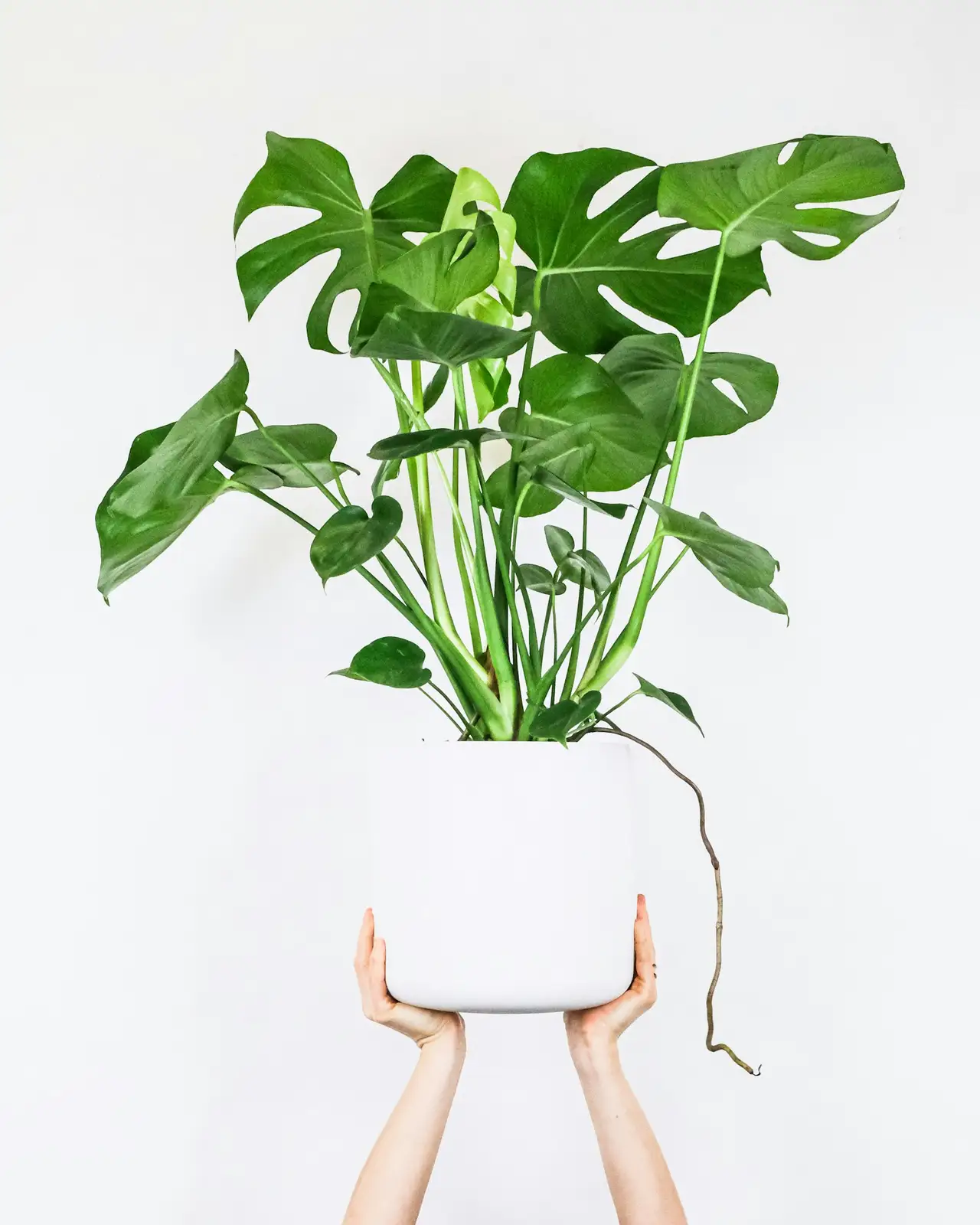
The big one: massive fenestrated (split and holed) leaves, the plant most people picture when they hear “monstera.” This is the one explicitly listed in the ASPCA database. Common names include Swiss Cheese Plant, Hurricane Plant, Cutleaf Philodendron (which is a misnomer; it is not a true Philodendron), Ceriman, and Mexican Breadfruit. Toxic to cats and dogs.
Monstera adansonii (Swiss Cheese Vine)
The smaller, vining cousin of deliciosa. Smaller leaves with more holes than splits. Trails or climbs. Often sold in hanging baskets, which makes it especially tempting for cats that can reach hanging plants. Same family (Araceae), same calcium oxalate crystals. Toxic to cats.
Monstera Thai Constellation, Albo, and other variegated varieties
Variegation refers to the white or cream patches on the leaves caused by cells that lack chlorophyll. These cultivars are visually different but chemically identical to the green parents. Thai Constellation (stable creamy variegation), Albo Variegata (unstable white-and-green variegation), Aurea (yellow variegation), and Mint (light green variegation) are all variants of Monstera deliciosa and share the same toxin. All toxic to cats.
Other Monstera species (siltepecana, dubia, standleyana, peru)
Less common in the houseplant trade but increasingly available. All are in the genus Monstera (or formerly classified as Monstera and now in adjacent genera), all in the family Araceae, all contain calcium oxalate crystals. All toxic to cats.
The rule: if it is sold as a Monstera, or if it is in the Araceae family, treat it as toxic. There is no “safe Monstera” variety.
When monstera toxicity becomes an emergency
The vast majority of monstera ingestions are uncomfortable but self-limiting. These are the rare cases where it is genuinely urgent:
- Visible swelling of the tongue, lips, or throat that is increasing. Calcium oxalate can cause significant inflammation in sensitive cats. If you can see the swelling worsen over 30 minutes, this is a vet visit, not a watch-at-home.
- Difficulty breathing or stridor (noisy breathing). Indicates airway involvement. Genuine emergency.
- Repeated vomiting that does not stop after the first hour. Dehydration risk for small cats and kittens.
- Refusal to drink water for more than 12 hours. Cats can dehydrate quickly, and a monstera-irritated mouth can make drinking painful enough that they avoid it.
- Kitten or senior cat with existing conditions. Lower margins for error.
We are not veterinarians. The information above is drawn from ASPCA reference materials, Pet Poison Helpline publicly available guidance, and standard veterinary references on calcium oxalate plant toxicity. For specific concerns about your cat, call your vet, the Pet Poison Helpline (855-764-7661), or the ASPCA Animal Poison Control Center (888-426-4435).
What about dogs?
Yes, monstera is toxic to dogs by the same mechanism. The ASPCA classifies Monstera deliciosa as toxic to both cats and dogs, with the same insoluble calcium oxalate crystals causing the same oral irritation, drooling, vomiting, and difficulty swallowing.
A few practical differences: dogs are generally larger than cats and may need to eat more plant material to show significant symptoms, but small dogs can be more affected than large dogs by the same amount. Dogs are also more likely to be willing to drink water and self-flush, which helps. The same emergency phone numbers apply (Pet Poison Helpline 855-764-7661, ASPCA APCC 888-426-4435). The same advice applies: watch for symptoms, call if anything is severe or persistent, and keep monstera at a height your dog cannot reach.
How to keep your monstera if you have cats
The brand position at Fern & Feline is that you usually don’t have to choose between your plants and your pets. With monstera, the safest answer is to swap it for a cat-safe alternative (see the next section), but if you are committed to keeping the plant, here is how to manage the risk. (For the full care side of that decision, see our monstera plant care guide, which covers light, water, repotting, propagation, and the common monstera troubleshooting questions in a cat household.)
Placement
- Height is your first line of defense. A mature monstera with a moss pole is six feet tall or more, and the lower leaves are at cat-jumping range. Position the plant so the lowest leaf is at least four feet above the nearest furniture a cat can launch from.
- No nearby launchpads. Cats can leap five to six feet horizontally from a flat starting surface. Bookshelves, sofa arms, and side tables next to the plant are launching pads. Move them or move the plant.
- Plant rooms with closed doors. The most reliable solution for serious plant collectors with cats. A room or sunroom the cat does not access keeps the toxic collection separate from the pet.
Deterrents
- Citrus spray. Cats dislike citrus oils. A diluted citrus spray on the lower leaves and the soil surface deters most cats. Reapply weekly.
- Double-sided tape on the pot rim. Cats avoid sticky paws. Effective on small pots, less so on large floor planters.
- Motion-activated air canisters (SSSCAT or similar). Effective but expensive and require maintenance. Best for one specific problem plant the cat has fixated on.
Redirects
The most reliable strategy is to give the cat something else to chew. Cats often eat plants because they want plant fiber in their diet, and offering a safe option redirects the behavior.
- Cat grass (oat grass, wheat grass, barley grass): chewable, safe, and many cats prefer it to houseplants once they have access. The most effective single deterrent for a plant-chewing cat.
- Catnip plants (Nepeta cataria): a fresh plant in addition to dry catnip toys.
- Cat-safe houseplants in the cat’s normal range: if there is a safe plant they can actually reach, they often leave the high-up toxic plants alone.
Pet-safe alternatives that look like monstera
If you want the big-leaf, tropical, statement-plant look without the toxicity, here are non-toxic alternatives the ASPCA classifies as safe for cats:
Cast Iron Plant (Aspidistra elatior), the closest cat-safe match for sheer presence. Long, broad, dark-green leaves up to two feet long. Slow-growing but hard to kill. Tolerates low light and irregular watering, which monstera does not. ASPCA non-toxic to cats and dogs.
Parlor Palm (Chamaedorea elegans), gives the tropical look with multiple narrow fronds. Smaller than monstera but visually similar in the “indoor jungle” sense. ASPCA non-toxic. The most-recommended cat-safe palm.
Calathea / Prayer Plant (Calathea, Maranta, Stromanthe species), patterned leaves with strong visual interest. Smaller than monstera but more cat-safe-living-room-photogenic. ASPCA non-toxic. Some humidity required.
Boston Fern (Nephrolepis exaltata), soft, feathery fronds that fill a corner. ASPCA non-toxic, like every true fern. Some humidity required.
Areca Palm (Dypsis lutescens), large feathery fronds, multi-stem clumping form, can grow to six feet tall indoors. The closest cat-safe substitute for monstera’s vertical impact. ASPCA non-toxic. See more big-plant options in our guide to cat-safe indoor trees.
For the full list of cat-safe houseplants organized by use case (low-light, hanging, statement, easy-care, edible), see our cat-safe houseplants pillar guide.
What to skip
A few things you do not need to do, despite what the internet might suggest:
- Do not induce vomiting at home. Methods that work for dogs (hydrogen peroxide) are not safe for cats. If a vet wants vomiting induced, they will do it themselves with proper medication.
- Do not give milk. This is folk advice for “neutralizing” oral irritation. It does not neutralize calcium oxalate, and many cats are lactose-intolerant, which adds GI upset to the calcium oxalate GI upset.
- Do not force-feed water with a syringe. If your cat is willingly drinking water, fine. If they are refusing because their mouth hurts, syringing water in can cause aspiration. Better to let the helpline guide you on hydration if it becomes a concern.
- Do not panic and head straight to the ER. Call the helpline first. They will tell you whether it’s a watch-at-home or an ER visit. Most cases are watch-at-home, and the ER visit costs $200 to $800 for monitoring of a self-limiting condition.
- Do not assume “rarely an emergency” means “never an emergency.” Pay attention to the genuine warning signs above. Most cases resolve on their own; some need vet support.
Frequently asked questions
Are monstera leaves toxic to cats? Yes. Every part of the monstera plant (leaves, stems, sap, aerial roots, unripe fruit) contains insoluble calcium oxalate crystals. The leaves are the most-chewed part because of size and accessibility, but no part of the plant is safe.
What happens if a cat eats a monstera? Most cats experience immediate mouth irritation (pawing, drooling, head-shaking) within minutes. Vomiting may follow within an hour or two. Symptoms peak in the first few hours and resolve within 12 to 24 hours. Kidney or liver damage is not a risk with monstera.
How long does monstera toxicity last in cats? Most cats recover within 12 to 24 hours. The intense oral symptoms peak in the first hour and fade. Vomiting, if it occurs, resolves on its own. If symptoms last longer than 24 hours, lethargy worsens, or your cat stops eating, call your vet.
Are Monstera adansonii (Swiss Cheese Vine) toxic to cats? Yes. Monstera adansonii is in the same genus and family as Monstera deliciosa and contains the same calcium oxalate crystals. The toxicity profile is identical. The same applies to Thai Constellation, Albo, and every other Monstera variety in the houseplant trade.
Is monstera fruit safe for cats? No. The ripe fruit is edible for humans (it tastes like a pineapple-banana hybrid), but the unripe fruit is significantly more irritating than the leaves due to extra calcium oxalate. Cats should not eat any part of a monstera, ripe or unripe, fruit included.
Can I keep my monstera if I have a cat? It is possible (high placement, deterrents, redirects), but not recommended. The closest cat-safe substitutes for monstera’s statement-plant impact are the Cast Iron Plant (for size), Areca Palm (for vertical fronds), and Calathea / Prayer Plant (for patterned leaves).
Is Monstera deliciosa the same as a split-leaf philodendron? No, despite the common confusion. Monstera deliciosa is sometimes sold mislabeled as “split-leaf philodendron,” but it is in a different genus. Both genera are in the Araceae family and share the same calcium oxalate toxin, so the safety verdict is unchanged: both are toxic to cats.
Related toxic plants in the Araceae family
If you have a monstera, you might also have other plants in the same family. They share the same toxin and the same general symptom profile:
- Pothos (Epipremnum aureum), the trailing vine in heart-shaped variations
- Peace Lily (Spathiphyllum), the white-flowered plant that is not a true lily
- Philodendron (Philodendron hederaceum and many others), often mislabeled as pothos and vice versa
- Dieffenbachia (Dieffenbachia spp.), also called dumb cane
- Alocasia (Alocasia spp.), including African Mask, Polly, Frydek
- Caladium (Caladium spp.), the heart-shaped colorful-leaf plant
- Xanthosoma and Colocasia (Elephant Ear), large-leaf statement plants
All toxic to cats by the same mechanism. The phone numbers and the symptom timeline are the same for the whole family.
Sources and further reading
- ASPCA Animal Poison Control: Swiss Cheese Plant (Monstera deliciosa)
- Pet Poison Helpline, 855-764-7661
- AVMA household hazards for pets
- Our are pothos toxic to cats guide, the closest mechanism match
- Our peace lily and cats guide, same family, different leaf type
- Our cat-safe houseplants pillar guide for non-toxic alternatives
- Our cat grass guide, the most effective single redirect for a plant-chewing cat
- Our monstera plant care guide, for readers who decide to keep their monstera and need the care side covered
If you arrived at this page in a panic because your cat just ate a monstera leaf, you can almost certainly relax. Monstera is uncomfortable for cats, but recovery is the rule, not the exception. Call the helpline if you have any doubt, give them something safe to chew on instead, and consider swapping the plant for a cat-safe alternative once everyone is okay.