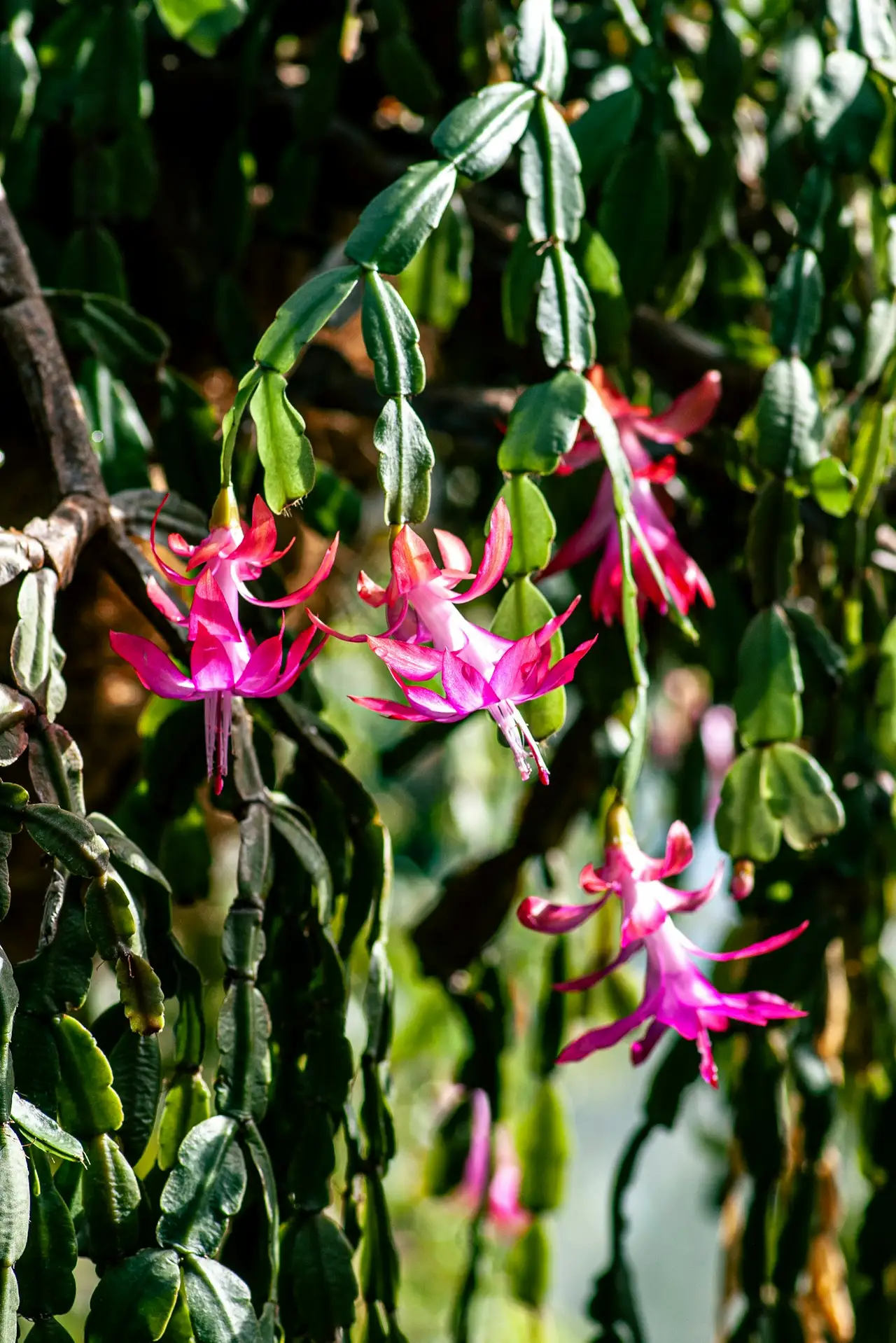
If your cat is eyeing the Christmas cactus on the windowsill, or you just caught it batting at those dangling stems, here is the reassuring answer: Christmas cactus is safe. Are christmas cactus toxic to cats? No. The ASPCA classifies the Christmas cactus (Schlumbergera) as non-toxic to cats, dogs, and horses. It has no poison and, despite the name, no sharp spines. It is one of the genuinely cat-safe holiday plants.
There is one honest caveat worth a sentence, and this guide covers it: non-toxic does not mean a cat should eat the whole plant. This guide gives you the sourced verdict, what actually happens if your cat overdoes it, the whole holiday-cacti family (Thanksgiving and Easter cactus included), why your cat is so drawn to it, and which festive plants actually are dangerous. Every safety claim here is tied to the ASPCA and PetMD.
TL;DR
- Christmas cactus is non-toxic to cats. The ASPCA lists Schlumbergera as non-toxic to cats, dogs, and horses.
- No spines. Despite the name, it is not a true cactus and has no sharp spines.
- The whole holiday-cacti family is safe: Christmas, Thanksgiving, and Easter cactus (sometimes sold as zygocactus) share the non-toxic profile.
- The one caveat: a cat that eats a lot of any plant can get mild stomach upset, and a large amount of the fibrous stems carries a small blockage risk.
- It is not poisonous, so a nibble is a non-event; it is just not a food.
- Cats chew it because the dangling stems move like prey; redirect with cat grass.
- The dangerous holiday plants are others: true lilies, holly, mistletoe, and amaryllis.
Are christmas cactus toxic to cats? The short answer
No. The ASPCA classifies the Christmas cactus (Schlumbergera bridgesii) as non-toxic to cats, dogs, and horses. It contains no toxic principle, so a cat that brushes against it, bats the stems, or chews a flower is not at any risk of poisoning.
| Christmas cactus and cats | At a glance |
|---|---|
| Toxic to cats? | No, non-toxic per the ASPCA |
| Scientific name | Schlumbergera (family Cactaceae) |
| Covers | Christmas, Thanksgiving, and Easter cactus (zygocactus) |
| Sharp spines? | No, not a true cactus |
| Risk from eating it | None toxic; large amounts may cause mild GI upset or a fiber blockage |
| Kidney or organ risk? | None |
The honest calibration we apply to every plant: non-toxic does not mean a cat should eat a whole plant. Any plant in quantity can cause a temporary upset stomach, because a cat’s system is built for meat, not salad. But a curious nibble of Christmas cactus is genuinely nothing to worry about.
What the ASPCA and PetMD actually say
Two sources cover this well, and together they give the complete, honest picture.
The ASPCA lists the Christmas cactus (Schlumbergera bridgesii) as non-toxic to cats, dogs, and horses. That is the core verdict: no poison, no toxic principle, no organ risk.
PetMD, in an article reviewed by Renee Schmid, DVM, DABT, DABVT (a board-certified veterinary toxicologist), adds the useful nuance. Christmas cactus is “considered low in toxicity to cats but may cause mild to moderate stomach issues” if eaten, with symptoms that can include vomiting, diarrhea, lethargy, and loss of appetite. And PetMD makes the reassuring structural point plainly: “despite its name, the Christmas cactus is not a ‘true’ cactus and doesn’t have sharp spines like desert varieties.” So there is no mouth-injury risk from spines either.
Put together: the plant is safe (non-toxic, no spines), and the only realistic issue is the ordinary one that applies to any non-food plant, a cat that eats too much of it may get a mild, temporary stomach upset.
What happens if your cat eats a christmas cactus?
Most likely, nothing worth noting. Because the plant is non-toxic, a cat that chews a stem segment or a flower is not being poisoned, and there are no toxins to cause drooling, organ effects, or the drama a genuinely toxic plant would.
The realistic outcomes, in order of likelihood:
- A nibble: a non-event. No treatment, no worry.
- A bigger mouthful: possible mild, temporary stomach upset, vomiting, loose stool, or a briefly reduced appetite, because the cat’s digestive system is not built for fibrous plant material. This resolves on its own.
- A large amount (uncommon): per PetMD, eating a lot of the fibrous stems carries a small risk of gastrointestinal blockage, where undigested plant material obstructs the stomach or intestines, with vomiting often the first sign. This is the one scenario that warrants a vet call, and it takes a determined eater to reach it.
So the practical guidance is calm: a nibble needs no action, and a bigger mouthful means watching for mild, brief stomach upset. Call your vet if vomiting is repeated or persistent, if your cat seems lethargic rather than briefly queasy, or if you know your cat ate a large amount of the plant.
Christmas, Thanksgiving, Easter, and zygo cactus: the whole holiday-cacti family
The holiday cacti are a small, confusingly-named family, and the good news is that they all share the same reassuring profile.
- Christmas cactus (Schlumbergera bridgesii): the ASPCA-listed non-toxic plant this article is about.
- Thanksgiving cactus (Schlumbergera truncata): the same genus, blooms a few weeks earlier, and PetMD names it among the related holiday cacti; considered non-toxic.
- Easter cactus: the ASPCA’s Christmas cactus entry actually lists “Easter Cactus” among its common names, so it is covered by the same non-toxic classification.
- Zygocactus: an older name you may see on plant tags for the same Schlumbergera holiday cacti.
So you do not need to identify exactly which holiday cactus you have, or worry that a differently-named one is secretly toxic. The whole spineless holiday-cacti group is cat-safe, with the same single caveat about a cat overeating fibrous plant material.
Why does my cat love my christmas cactus?
If your cat keeps going after the plant, it is not because the plant is harming it, and it is worth understanding the why so you can redirect the behavior.
The Christmas cactus has long, segmented stems that trail and dangle, especially from a hanging pot or a shelf edge. Those stems move and swing when brushed or when the air shifts, and movement is exactly what triggers a cat’s prey-and-play instinct. Add the fleshy, satisfying texture of the segments, and you have a plant a cat wants to bat, grab, and chew. This is normal cat behavior, not a sign of a problem.
The fix is redirection, not banishment, since the plant is safe:
- Give your cat its own chew target. A pot of cat grass gives a plant-curious cat something it is actually meant to nibble, which lowers interest in your other plants.
- Place the trailing stems out of easy reach. A hanging spot without a nearby launching surface removes the swinging temptation.
- Accept the occasional nibble. Because it is non-toxic, a cat that gets a mouthful now and then is fine; you are managing your plant’s looks more than your cat’s safety.
The holiday plants that ARE dangerous to cats
Christmas cactus is one of the safe ones, which is worth knowing precisely because several popular holiday plants are genuinely dangerous, and that is where your vigilance belongs.
- True lilies (Lilium and Hemerocallis) are the most dangerous of all: even pollen or vase water can cause fatal kidney failure in cats. We cover them in our guide to whether lilies are toxic to cats, and they should never be in a cat home.
- Holly, mistletoe, and amaryllis are all toxic to cats and common in holiday decor.
- Poinsettia is often over-feared: it is mildly irritating rather than the deadly plant of legend, as we explain in our guide on whether poinsettias are poisonous to cats.
So the useful holiday rule for cat owners: Christmas cactus, safe; true lilies, an emergency; and most of the rest sit somewhere in between. Knowing which is which is the whole game.
Are christmas cactus toxic to dogs?
No. The same ASPCA entry lists the Christmas cactus as non-toxic to dogs as well as cats and horses. As with cats, the only realistic issue is a dog that eats a large amount getting mild stomach upset, or a very large quantity of the fibrous stems posing a small blockage risk. The plant is not poisonous to dogs and has no spines, so it is a safe choice for a dog household too.
What to do if your cat overdid it
For the rare case where your cat ate more than a nibble:
- Take the plant away and clear any chewed pieces your cat will let you reach.
- Offer water and just watch for a few hours. Expect at most some mild stomach upset that passes on its own.
- Do not induce vomiting or give home remedies; it is unnecessary for a non-toxic plant and can cause more harm than the plant.
- Call for help if it does not stay mild. Repeated or persistent vomiting, lethargy, refusal to eat, or knowing your cat ate a large amount of the fibrous stems are the escalation signs. Your vet, the ASPCA Animal Poison Control Center (888-426-4435), or Pet Poison Helpline (855-764-7661) can triage by phone.
Frequently asked questions
Are Christmas cactus toxic to cats?
No. The ASPCA classifies the Christmas cactus (Schlumbergera) as non-toxic to cats, dogs, and horses. It contains no poison, and unlike a desert cactus it has no sharp spines. It is one of the genuinely cat-safe holiday plants. The only caveat is that a cat that eats a large amount of any plant can get mild stomach upset, and a very large amount of the fibrous stems could risk a digestive blockage, so it is safe but not a snack.
What happens if my cat eats a Christmas cactus?
Usually very little. Because it is non-toxic, a cat that chews a stem or flower is not being poisoned. Per PetMD, the plant is low in toxicity but can cause mild to moderate stomach issues if eaten, meaning vomiting, diarrhea, lethargy, or a reduced appetite, and a large amount of the fibrous plant carries a small risk of gastrointestinal blockage. A nibble is a non-event; watch for more than mild or persistent vomiting and call your vet if it does not settle.
Are Thanksgiving and Easter cactus also safe for cats?
Yes. The Thanksgiving cactus and Easter cactus are close relatives of the Christmas cactus in the same holiday-cacti group, and they are considered non-toxic to cats too. The ASPCA’s Christmas cactus entry even lists Easter Cactus among its common names. All of these spineless holiday cacti (sometimes sold as zygocactus) carry the same reassuring, non-toxic profile, with the same minor caveat about a cat overeating fibrous plant material.
Why does my cat keep chewing my Christmas cactus?
The dangling, segmented stems move and swing like prey, which triggers a cat’s natural urge to bat and chew, and some cats simply like the texture of the fleshy segments. It is a behavior issue, not a sign the plant is harming your cat. The fix is to redirect the urge: give your cat its own pot of cat grass to chew, and place the Christmas cactus where the trailing stems are out of easy reach so it is not a swinging temptation.
Are Christmas cactus toxic to dogs?
No. The same ASPCA entry lists the Christmas cactus as non-toxic to dogs as well as cats and horses. As with cats, the only realistic issue is a dog that eats a large amount getting mild stomach upset, or a very large amount of the fibrous stems posing a small blockage risk. The plant itself is not poisonous to dogs, and it has no spines.
The bottom line
Christmas cactus is one of the genuinely easy ones. The ASPCA lists it as non-toxic to cats, it has no spines, and the whole holiday-cacti family (Thanksgiving and Easter cactus included) shares that safe profile. The only honest caveat is the ordinary one: a cat that eats a large amount of any plant can get a mild stomachache, and a lot of the fibrous stems carries a small blockage risk, so it is safe but not a snack. Give your plant-curious cat a pot of cat grass to redirect the chewing, keep the true lilies out of the house, and you can enjoy a blooming Christmas cactus and a curious cat in the same room.
Sources: ASPCA, Christmas Cactus (non-toxic to cats and dogs) | PetMD, Is a Christmas Cactus Poisonous to Cats? (reviewed by Renee Schmid, DVM, DABT, DABVT)