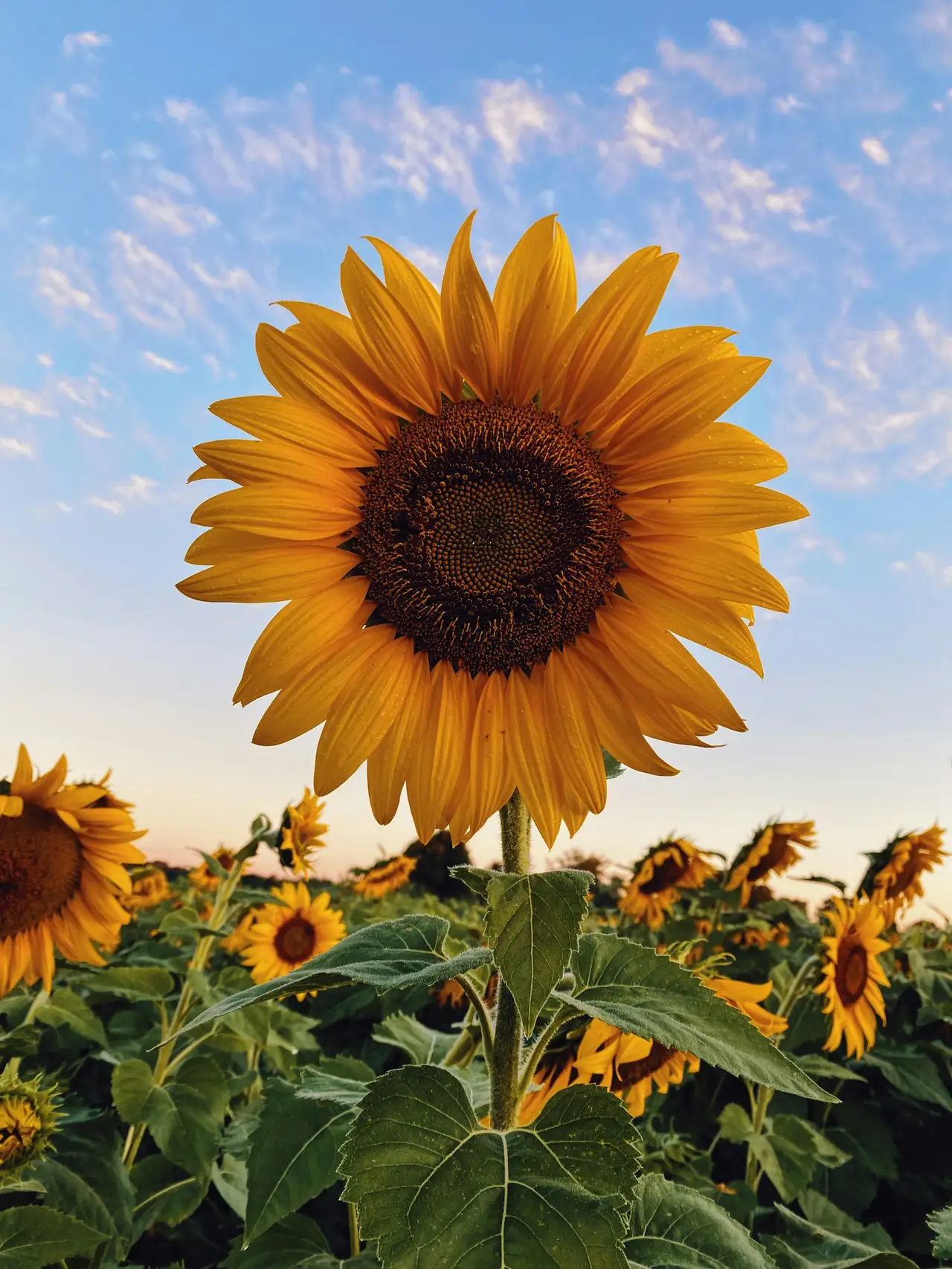
If you brought home a bunch of sunflowers, or your cat is eyeing the one on your table, here is the easy answer: sunflowers are safe. Are sunflowers toxic to cats? No. The ASPCA lists the sunflower as non-toxic to cats, and that includes the part people worry about most, the pollen. Unlike a true lily, a sunflower is a flower a cat can sniff, brush against, or even nibble without any risk of poisoning.
This guide gives you the sourced verdict, then the useful context the thin pages skip: why sunflowers are safe when their close cousin the chrysanthemum is toxic, what really happens if your cat eats one, where the seeds and oil fit in, and which flowers actually are the dangerous ones. Every safety claim here is sourced to the ASPCA.
TL;DR
- Sunflowers are safe for cats. The ASPCA lists the sunflower (Helianthus) as non-toxic to cats, dogs, and horses.
- The pollen is safe too, which is the opposite of true lilies, whose pollen can be fatal to cats.
- Eating a lot of any plant can cause mild, brief stomach upset, but a sunflower nibble is a non-event.
- Same family, opposite verdict: sunflowers share the Asteraceae family with the toxic chrysanthemum and marigold, yet sunflowers are safe. The family name does not decide toxicity.
- Sunflower seeds: plain kernels are not toxic but not needed; avoid the shells (choking) and salted/seasoned seeds.
- Sunflower oil is a cooking oil, not a concentrated essential oil, so it is not the essential-oil hazard.
- The genuinely dangerous flowers are true lilies. If you are unsure what your cat got into, identify it first.
Are sunflowers toxic to cats? The short answer
No. The ASPCA classifies the sunflower (Helianthus) as non-toxic to cats, dogs, and horses. The everyday garden and florist sunflower (Helianthus annuus) belongs to that same genus, so the classification covers the tall yellow flower you are picturing. A cat can be around sunflowers, chew a petal, or get pollen on its fur with no risk of poisoning.
| Sunflowers and cats | At a glance |
|---|---|
| Safe for cats? | Yes, non-toxic per the ASPCA |
| Scientific name | Helianthus (family Compositae / Asteraceae) |
| Covers | Common garden and florist sunflowers (Helianthus annuus) |
| Pollen risk | None (unlike true lilies) |
| Risk from eating it | None toxic; large amounts may cause mild GI upset |
| Seeds and oil | Plain kernels and cooking oil are non-toxic; see below |
The honest calibration we apply to every plant: non-toxic does not mean a cat should eat a whole flower head. Any plant in quantity can cause a temporary upset stomach because it is not part of a cat’s diet. But a curious nibble of sunflower is genuinely nothing to worry about.
Same family, opposite verdict: sunflowers vs. the toxic Asteraceae
Here is the piece worth understanding, because it explains a confusion that trips up a lot of cat owners.
Sunflowers belong to the Asteraceae family (also called Compositae), the daisy family. That same family includes plants that ARE toxic to cats, most notably the chrysanthemum and the marigold, which carry pyrethrins and sesquiterpene lactones. So you cannot judge a flower by its family. Two flowers can be close botanical cousins and land on opposite sides of the safe-toxic line.
The sunflower is the safe cousin. It does not contain the pyrethrins that make mums mildly toxic, and the ASPCA places it firmly in the non-toxic column. So a daisy-shaped flower is not automatically a worry, and a sunflower specifically is one of the reassuring ones. This is exactly why we verify each flower individually rather than trusting a family rule of thumb, the approach behind our roundup of cat-safe flowers vetted against the ASPCA list.
What happens if your cat eats a sunflower?
Most likely, nothing worth noting. Because the sunflower is non-toxic, a cat that chews a petal, a leaf, or even the flower head is not being poisoned. There are no toxins to cause drooling, vomiting, or organ effects the way a toxic plant would.
The only realistic outcome is a volume issue. A cat that eats a large amount of any plant material, sunflower included, may vomit it back up or pass loose stool, simply because its digestive system is built for meat, not salad. That is uncomfortable but harmless, and it resolves on its own.
So the practical guidance is calm: a nibble needs no action, and a bigger mouthful means watching for mild, brief stomach upset. The only reason to call your vet is vomiting that is repeated, persistent, or paired with lethargy, which would point to something other than the sunflower.
Are sunflower seeds safe for cats?
Plain sunflower seeds are not toxic, but they are not a cat food, and there are two real cautions.
First, the shells. The fibrous outer shell of a sunflower seed is a choking hazard and can irritate or, in a determined eater, obstruct a cat’s gastrointestinal tract. If a cat is going to have a seed at all, it should be the shelled kernel only.
Second, the seasoning. Most sunflower seeds people buy are salted, roasted, or flavored, and the added sodium and seasonings are not something a cat should eat. A plain, unsalted, shelled kernel is harmless in a tiny amount, but it offers a cat no nutritional benefit. Sunflower seeds are not a treat to feed on purpose, just a thing that will not hurt your cat if one falls on the floor.
Is sunflower oil safe for cats?
Yes, in the ordinary sense. Sunflower oil is a culinary cooking oil pressed from the seeds, and it is not the same as a concentrated essential oil. This distinction matters, because concentrated essential oils are genuinely risky for cats, while a cooking oil is not.
A small amount of sunflower oil, the kind that might be on a piece of food, is not toxic. A large amount can cause loose stool or mild stomach upset, the way too much fat would in any form, but it is not a poisoning concern. Keep the perspective straight: sunflower cooking oil is benign, sunflower essential oil (a different, concentrated product) would be the thing to keep away, and the plant itself is simply safe.
The flowers that ARE dangerous: lilies and the real risks
Since the relief of a safe sunflower is most useful next to a clear picture of the genuine dangers, here is the contrast.
The most dangerous flower for cats is the true lily. True lilies (Lilium and Hemerocallis species, including Easter, Tiger, Asiatic, Oriental, and daylilies) cause fatal kidney failure in cats, and the danger is extreme: even pollen groomed off the fur or water from the vase can be fatal, and a small exposure is a true emergency. We cover that in full in our guide to whether lilies are toxic to cats.
This is the exact reason sunflowers are such a relief by comparison. With a sunflower, the pollen is harmless, the petals are harmless, and there is no scenario where a normal household sunflower poisons your cat. The toxic-but-mild flowers like peonies and chrysanthemums sit in the middle, and the cat-safe flowers like sunflowers and roses sit at the easy end. Knowing which flower is which is the whole game.
Cut sunflowers, silk sunflowers, and what to skip
A few practical notes for the real situations sunflowers show up in.
- Rinse florist sunflowers. Cut flowers from a shop can carry pesticide or flower-food residue, and the little packet of cut-flower preservative is not cat-safe. The flower is fine; the chemicals on it are the part to manage. Rinse stems and keep the preservative packet away from your cat.
- Silk and artificial sunflowers are a different kind of risk. A fake sunflower is not a poisoning hazard, but the fabric, wire, and dyes can cause a choking or gastrointestinal-obstruction problem if a cat chews and swallows pieces. Treat artificial flowers like any non-food object a cat should not eat.
- Skip the worry about the plant itself. Sunflowers are non-toxic, so a chewed petal or a dusting of pollen needs no action.
- Skip feeding sunflower seeds as a treat. They are not harmful in tiny plain amounts, but they are not a cat food, and the shells and salt are the parts that cause problems.
Frequently asked questions
Are sunflowers safe for cats?
Yes. The ASPCA classifies the sunflower (Helianthus) as non-toxic to cats, dogs, and horses. A cat can sniff, brush against, or nibble a sunflower without being poisoned, and the pollen is safe too. The only caveat is that eating a large amount of any plant can cause mild, temporary stomach upset, simply because plants are not part of a cat’s normal diet.
What happens if a cat eats a sunflower?
Most likely nothing, or at worst a brief, mild stomach upset. Because the sunflower is non-toxic, a cat that chews a petal or leaf is not at risk of poisoning. If a cat eats a large quantity of plant material it may vomit it back up, which is a volume issue rather than a toxicity one. Watch for more than mild or persistent vomiting, and call your vet if it does not settle, but a nibble needs no action.
Are sunflower seeds safe for cats?
Plain, shelled, unsalted sunflower seeds are not toxic to cats, but they are not a food a cat needs. The real cautions are the shells, which are a choking and gastrointestinal-irritation risk, and salted or seasoned seeds, which add sodium and flavorings a cat should not have. A stray plain kernel is harmless; sunflower seeds are not a recommended cat treat.
Is sunflower pollen dangerous to cats like lily pollen?
No. Sunflower pollen is not dangerous to cats. This is the opposite of true lilies, whose pollen alone can cause fatal kidney failure in cats when groomed off the fur. Sunflowers carry no such hazard in any part, including the pollen, so a cat brushing against a sunflower or getting pollen on its coat is not at risk.
What is the most toxic flower for cats?
True lilies (Lilium and Hemerocallis species, such as Easter, Tiger, Asiatic, and daylilies) are the most dangerous flowers for cats. Every part, including the pollen and the vase water, can cause fatal kidney failure, and even tiny exposures are an emergency. Sunflowers are the reassuring opposite: a genuinely cat-safe flower. If you are unsure which flower your cat encountered, identify it before assuming it is safe.
The bottom line
Sunflowers are one of the genuinely easy ones. The ASPCA lists them as non-toxic to cats, the pollen is harmless, and the worst a curious cat faces is a mild stomachache from overdoing it. Keep the salted seeds and the cut-flower chemicals out of reach, remember that a sunflower’s toxic cousin the chrysanthemum is the one to watch in that family, and you can fill a vase with sunflowers and let your cat share the windowsill. The flowers that truly demand caution are the lilies, not these.
Sources: ASPCA, Sunflower (non-toxic to cats and dogs) | ASPCA, Which Lilies Are Toxic to Pets?