You want a real tree in your living room, the kind that fills a corner and makes the space feel finished. The catch in a cat household is that the two most popular statement trees right now, the fiddle-leaf fig and the rubber tree, are both toxic to cats, and one plant sold as an indoor “palm,” the sago palm, can kill a cat outright. The good news: cat-safe indoor trees are easy, they are mostly palms, and they give you the same architectural look. Here are nine that are ASPCA-verified non-toxic, and the seven toxic ones to keep out.
The quick answer
Per the ASPCA, nine common indoor trees and large floor plants are non-toxic to cats: parlor palm, areca palm, bamboo palm, kentia palm, majesty palm, ponytail palm, money tree, Norfolk Island pine, and banana. Most are palms, and palms are the reliable route to a big cat-safe statement plant. The trees to avoid are the fiddle-leaf fig, rubber tree, weeping fig, dracaena (dragon tree and corn plant), yucca, schefflera, and above all the sago palm, which causes liver failure.
At a glance: cat-safe indoor trees vs. the toxic look-alikes
| Tree | Scientific name | Safe for cats? | Note |
|---|---|---|---|
| Parlor palm | Chamaedorea elegans | Yes | Tolerates low light, stays compact |
| Areca palm | Dypsis lutescens | Yes | Grows 5-6 ft, the classic floor palm |
| Bamboo palm | Chamaedorea | Yes | Upright, good in medium light |
| Kentia palm | Howea forsteriana | Yes | Elegant, can reach 8 ft |
| Majesty palm | Ravenea rivularis | Yes | Feathery, wants bright light |
| Ponytail palm | Beaucarnea recurvata | Yes | A succulent, drought-tolerant |
| Money tree | Pachira aquatica | Yes | Braided trunk, non-palm tree shape |
| Norfolk Island pine | Araucaria heterophylla | Yes | The cat-safe living Christmas tree |
| Banana | Musa | Yes | Big paddle leaves, wants bright light |
| Fiddle-leaf fig | Ficus lyrata | No | A Ficus; toxic sap |
| Rubber tree | Ficus elastica | No | A Ficus; toxic sap |
| Dracaena / dragon tree | Dracaena spp. | No | Toxic; includes corn plant |
| Yucca | Yucca spp. | No | Toxic; vomiting |
| Schefflera / umbrella tree | Schefflera | No | Toxic; oral burning |
| Sago palm | Cycas revoluta | No, severe | Liver failure and death |
The trap: the trendiest statement trees are toxic to cats
Before the safe list, the calibration that matters most, because it is the part buyers get wrong.
The three big floor plants people most want right now are, unfortunately, the three worst choices for a cat home.
The fiddle-leaf fig (Ficus lyrata) is the most photographed houseplant of the last decade, and it is a Ficus. The ASPCA classifies Ficus as toxic to cats; the sap contains an irritant that causes mouth irritation, drooling, and vomiting. There is no ASPCA entry titled “fiddle-leaf fig” (the ASPCA’s “Fiddle-Leaf” page is a different plant, a philodendron), but the fiddle-leaf fig’s genus is covered by the ASPCA’s Weeping Fig entry (Ficus sp., toxic to cats).
The rubber tree (Ficus elastica), sold with glossy burgundy or dark green leaves, is the same genus and carries the same toxic sap. Same verdict.
The sago palm (Cycas revoluta) is the dangerous one. It is not a true palm; it is a cycad, and it is sold in nurseries and big-box stores as a compact “palm” for tabletops and floors. Per the ASPCA’s sago palm entry, every part is toxic to cats, and the clinical signs are severe: “Vomiting, melena, icterus, increased thirst, hemorrhagic gastroenteritis, bruising, coagulopathy, liver damage, liver failure, death.” This is a liver-failure plant, not a stomach-ache plant. It does not belong in a home with any animal. The ASPCA also lists this plant under the name “fern palm”; our guide to ferns and cats explains why it is neither a fern nor a palm.
Here is the reassuring part. Every look these three plants give you, tall and architectural, glossy and tropical, compact and sculptural, has a cat-safe substitute below. You are not giving up the statement corner. You are swapping the species.
9 cat-safe indoor trees
Each of these has an individual ASPCA plant-database entry confirming non-toxic status for cats, and we verified each one before publishing. Non-toxic means it will not poison your cat; it does not mean a cat should eat it in volume, since any plant material can cause mild, temporary stomach upset.
1. Parlor palm (Chamaedorea elegans)
Per the ASPCA’s Parlor Palm entry, the parlor palm is non-toxic to cats and dogs. It is the easiest cat-safe palm to own: it tolerates low to medium indirect light, forgives inconsistent watering, and stays a manageable two to four feet. If you want one safe tree and you do not have a bright window, this is the pick. The parlor palm is also the plant behind several ASPCA listings (Good Luck Palm, Reed Palm, Bamboo Palm all map to Chamaedorea), so you have naming flexibility when you shop.
2. Areca palm (Dypsis lutescens)
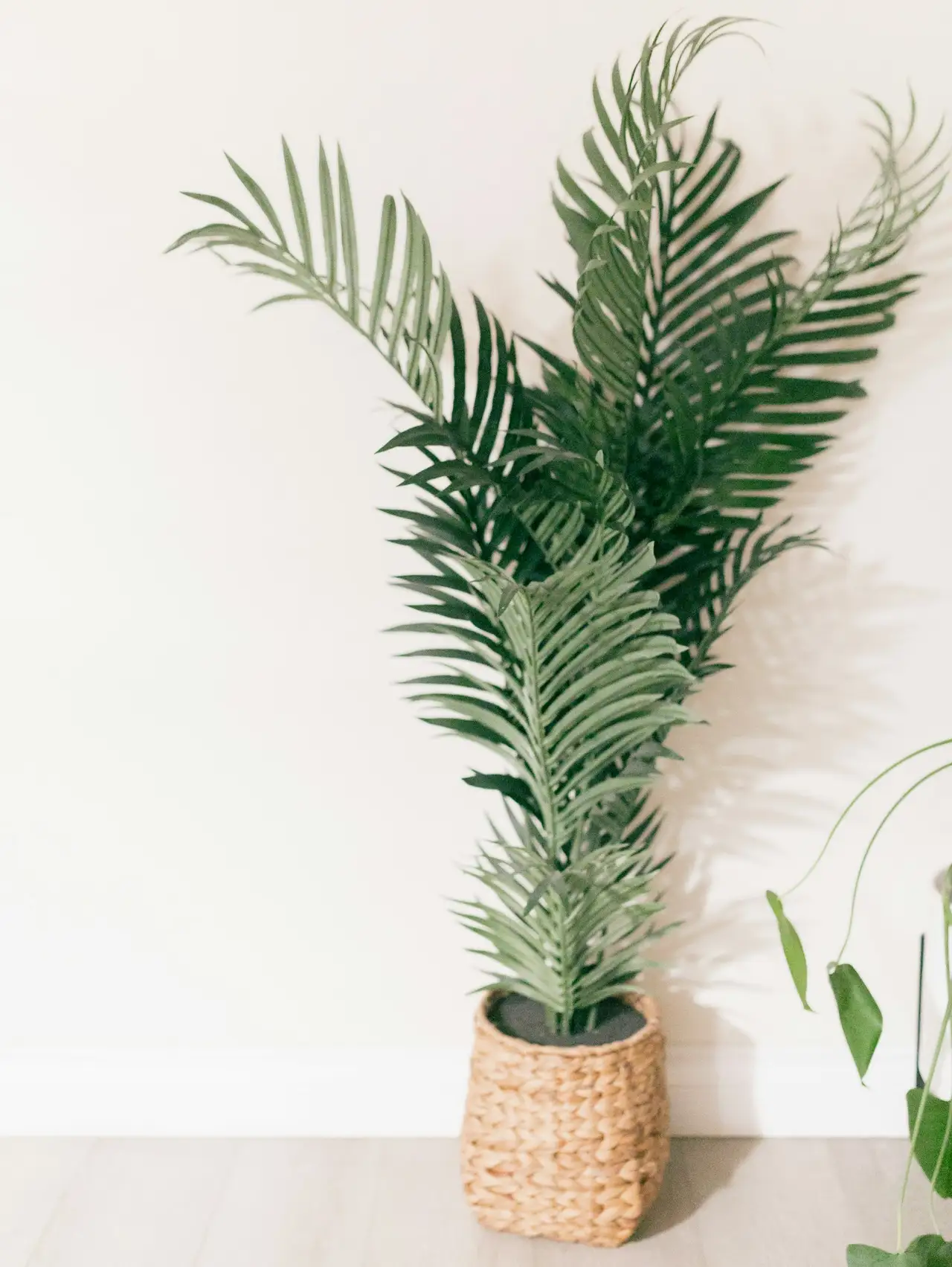
Per the ASPCA’s Areca Palm entry, the areca palm is non-toxic to cats, dogs, and horses. This is the classic floor palm: it grows to five or six feet indoors, wants bright indirect light, and reads as a full tropical corner. An areca in a heavy pot is the closest cat-safe match to the presence people buy a fiddle-leaf fig for.
3. Bamboo palm (Chamaedorea spp.)
Per the ASPCA’s Bamboo Palm entry, the bamboo palm is non-toxic to cats, dogs, and horses. Upright, clumping canes with feathery fronds, happy in medium light, and a good screen for a corner or a room divider. It is a Chamaedorea like the parlor palm, so it shares the same easy, cat-safe profile.
4. Kentia palm (Howea forsteriana)
Per the ASPCA’s Kentia Palm entry, the kentia palm is non-toxic to cats and dogs. It is the elegant, slightly formal palm you see in old hotel lobbies, and it can reach eight feet indoors while tolerating lower light than most large palms. If you want a big, refined floor tree and you are willing to pay a bit more, the kentia is the upgrade.
5. Majesty palm (Ravenea rivularis)
Per the ASPCA’s Majesty Palm entry, the majesty palm is non-toxic to cats, dogs, and horses. Full, feathery, and dramatic, it is the affordable big-box floor palm. It wants bright light and consistent moisture; it will sulk in a dark corner. Give it a sunny spot and it delivers the most fronds per dollar of any palm here.
6. Ponytail palm (Beaucarnea recurvata)
Per the ASPCA’s entry (listed as Bottle Palm, with common names Elephant-foot Tree and Pony Tail Plant), the ponytail palm is non-toxic to cats and dogs. Despite the name it is a succulent, not a true palm: a swollen water-storing trunk topped with a fountain of long, stringy leaves. Those leaves are unappealing to most cats, it tolerates being underwatered, and a mature one is genuinely sculptural. It is a strong pick for a chew-prone cat. For more on the succulents that are safe versus toxic, see our guide on whether succulents are toxic to cats.
7. Money tree (Pachira aquatica)
Per the ASPCA’s Money Tree entry, the money tree is non-toxic to cats, dogs, and horses. This is the best non-palm option: often sold with a braided trunk and a canopy of glossy palmate leaves, it gives you an actual tree shape rather than fronds. It wants bright indirect light and consistent moisture. Do not confuse it with the toxic jade plant, which is sometimes also called a “money plant”; the Pachira aquatica money tree is the safe one.
8. Norfolk Island pine (Araucaria heterophylla)
Per the ASPCA’s entry (listed as Australian Pine, with common names Norfolk Pine and Norfolk Island Pine), it is non-toxic to cats, dogs, and horses. It looks like a soft, symmetrical evergreen, and it is the genuinely cat-safe answer to the “living Christmas tree” question: a potted Norfolk Island pine can be decorated and kept year-round. It wants bright light and humidity.
9. Banana (Musa spp.)
Per the ASPCA’s Banana entry, banana is non-toxic to cats, dogs, and horses. The big paddle leaves give a bold, jungly look that no palm matches. It is a light-and-water hog, so it is for a bright room and an attentive waterer, but as a cat-safe statement plant it is unbeatable for drama.
Cat-safe indoor trees for low light
Not every home has a sunny corner. If your spot gets low to medium indirect light, three of the safe trees above will tolerate it:
- Parlor palm is the most shade-tolerant palm on the list and the safest low-light bet.
- Kentia palm handles lower light better than most large palms, which is part of why it was the classic Victorian parlor tree.
- Bamboo palm does well in medium light and away from direct sun.
Skip the majesty palm and banana in a dark room; both need bright light and will decline without it. For a fuller list of cat-safe plants that thrive in dim apartments, including non-tree options, see our cat-safe houseplants guide.
The toxic trees to keep out of a cat home
These are the large plants sold as indoor trees that are toxic to cats per the ASPCA. Most cause mild-to-moderate irritation; the sago palm is the exception and is an emergency.
- Fiddle-leaf fig and rubber tree (Ficus lyrata, Ficus elastica): both are Ficus, and the ASPCA classifies Ficus as toxic to cats via its Weeping Fig entry (Ficus sp.). Toxic sap causes mouth irritation, drooling, and vomiting.
- Weeping fig (Ficus sp.): the same genus, same toxic sap, per the ASPCA.
- Dracaena, including the dragon tree and corn plant (Dracaena spp.): per the ASPCA’s Dracaena entry, which covers corn plant, cornstalk plant, dragon tree, and ribbon plant, all are toxic to cats. Saponins cause vomiting (sometimes with blood), drooling, and lethargy.
- Yucca (Yucca spp.): per the ASPCA’s Yucca entry, toxic to cats, with vomiting the main sign.
- Schefflera / umbrella tree: per the ASPCA’s Schefflera entry, toxic to cats, causing “oral irritation, intense burning and irritation of the mouth, lips, tongue, excessive drooling, vomiting, difficulty in swallowing” from insoluble calcium oxalates.
- Sago palm (Cycas revoluta): the severe one. Per the ASPCA, it causes liver damage, liver failure, and death. This is not a manage-with-placement plant. It should not be in the home at all.
If your cat has chewed a sago palm, or any part of one, treat it as an emergency and call immediately:
- Pet Poison Helpline: 855-764-7661 (24/7)
- ASPCA Animal Poison Control Center: 888-426-4435 (24/7)
For the wider pattern of toxic plants that hide in plain sight, our aloe vera and cats guide covers another popular “safe-looking” plant that is not.
Are Christmas trees safe for cats?
This comes up every December, so the straight answer: a cut pine or fir is not classically poisonous, but it is not risk-free. The needles can cause mouth and stomach irritation if chewed, the sap is mildly irritating, and the tree stand water, especially with preservatives or after bacteria grow in it, is the bigger hazard if a cat drinks it.
If you want a living tree that is genuinely cat-safe, the Norfolk Island pine above is the answer: it is ASPCA non-toxic, it looks the part, and it can be decorated and kept year-round. The one thing to keep far away during the holidays is the sago palm, which sometimes appears in festive arrangements as a “palm”; it is severely toxic. For the holiday plants that matter most in a cat home, see our guides on whether poinsettias are poisonous to cats and whether Christmas cactus is toxic to cats.
How to choose and place a cat-safe tree
Picking a safe species is most of the job. A few practical moves handle the rest:
- Buy the size you want now. Palms grow slowly indoors. If you want a five-foot tree, buy a five-foot tree; do not count on a tabletop palm becoming a floor tree quickly.
- Use a heavy pot. A cat that climbs or leans on a floor plant can tip a lightweight plastic nursery pot. A heavy ceramic or a weighted basket keeps a big palm stable. This matters more than any deterrent.
- Match the light honestly. The single most common way a safe tree dies is the wrong light. Parlor and kentia palms for lower light; areca, majesty, banana, and money tree for bright rooms.
- Expect some chewing, plan for it. Even a non-toxic palm can give a cat a mild stomach ache if it grazes the fronds. A pot of cat grass nearby gives a determined chewer a legal target. For the full set of placement and deterrent tactics, see our guide on how to keep cats away from plants.
Where to buy: most of these palms are stocked at local nurseries and garden centers, which is the cheapest way to buy a large plant, and online plant retailers like The Sill and Bloomscape carry the areca, kentia, and money tree in floor sizes. Buying the safe palm in place of a fiddle-leaf fig is the whole move.
Are these trees safe for dogs too?
Mostly yes. Every tree on the safe list above is also non-toxic to dogs per its ASPCA entry: parlor, areca, bamboo, kentia, and majesty palms, ponytail palm, money tree, Norfolk Island pine, and banana are all listed non-toxic to both cats and dogs (and most to horses too). The same toxic list applies to dogs as well, and the sago palm is just as deadly to dogs as to cats. If you have a mixed-pet household, the nine safe trees work for everyone. For the dog side of common toxic plants, see our dog-safe plant guides.
What to skip
- Do not buy a fiddle-leaf fig or rubber tree for a cat home. They are the two trendiest floor trees and both are toxic Ficus. An areca or kentia palm gives the same look safely.
- Do not assume a plant labeled “palm” is safe. The sago palm is a cycad, not a palm, and it is the most dangerous plant in this whole article. Read the scientific name: Cycas revoluta is the one to refuse.
- Do not rely on placing a big tree “up high.” Floor trees are floor trees; you cannot shelve them. Safety here comes from species choice and a tip-proof pot, not height.
- Do not panic over a single chewed frond on a safe palm. A cat that nibbles an areca and vomits once is having a normal plant-chew reaction, not a poisoning. Non-toxic means no organ damage, not zero stomach upset.
- Do not induce vomiting at home if a cat eats a toxic tree. Call a helpline and let a professional decide; this matters most with the sago palm, where time is critical.
Frequently asked questions
What indoor trees are safe for cats? Per the ASPCA: parlor palm, areca palm, bamboo palm, kentia palm, majesty palm, ponytail palm, money tree, Norfolk Island pine, and banana. Most are palms, and palms are the reliable cat-safe route to a big statement plant.
What is the best indoor tree for a pet owner? The parlor palm (low light, compact) and the areca palm (bright light, five to six feet) are the best all-round picks. The money tree is the best non-palm option if you want a braided-trunk tree shape.
Is the fiddle-leaf fig toxic to cats? Yes. It is a Ficus, and the ASPCA classifies Ficus as toxic to cats. The rubber tree (also a Ficus) is the same. Swap either for an areca or kentia palm.
Are Christmas trees safe for cats? A cut pine or fir is not classically poisonous, but needles and tree-stand water are hazards. For a genuinely cat-safe living tree, the Norfolk Island pine is ASPCA non-toxic. Keep sago palms out entirely.
What large indoor trees are safe for cats? For real floor-tree height: areca palm, kentia palm (up to eight feet), majesty palm, banana, and the money tree. Put any large plant in a heavy, tip-proof pot.
Related articles
- Cat-Safe Houseplants, the master non-toxic plant list this tree guide sits under
- Are Succulents Toxic to Cats?, which covers the ponytail palm and the toxic sago-palm confusion in more depth
- Is Aloe Vera Toxic to Cats?, another popular “safe-looking” plant that is not
- Cat-Safe Flowers, the cut-flower companion to this floor-plant guide
Sources
Every safe tree is sourced to its individual ASPCA Animal Poison Control plant entry, each verified before publishing.
- ASPCA: Toxic and Non-Toxic Plant List for Cats
- ASPCA: Parlor Palm, Areca Palm, Bamboo Palm, Kentia Palm, Majesty Palm
- ASPCA: Ponytail / Bottle Palm, Money Tree, Norfolk Island / Australian Pine, Banana
- ASPCA (toxic): Weeping Fig, Dracaena, Yucca, Schefflera, Sago Palm
- Pet Poison Helpline, 855-764-7661, 24/7 veterinary toxicology line
The reliable summary: cat-safe indoor trees are mostly palms, parlor and areca for most homes, kentia and majesty for a bigger statement, money tree and Norfolk Island pine when you want a non-palm shape. Keep the fiddle-leaf fig and rubber tree out because they are toxic Ficus, and keep the sago palm out because it can be fatal.