Are poinsettias poisonous to cats? Technically yes, but the famous “poinsettias kill cats” story is one of the most-repeated wrong facts in pet content. The ASPCA classifies poinsettia toxicity as mild and “generally over-rated.” Pet Poison Helpline calls the poisoning “greatly exaggerated.” If your cat just chewed on a poinsettia leaf, you almost certainly do not have a medical emergency on your hands.
This is the calibrated answer the search results bury 800 words deep. We are putting it at the top.
The quick answer
Poinsettias (Euphorbia pulcherrima) are mildly toxic to cats. The milky white sap in the leaves and stems is an irritant. Most cats who chew a poinsettia get drooling, a little stomach upset, maybe one episode of vomiting, and then recover at home over 12 to 24 hours without veterinary treatment.
If your cat ingested any part of a poinsettia and you’re worried, the right call right now is:
- ASPCA Animal Poison Control: (888) 426-4435 (a consultation fee may apply)
- Pet Poison Helpline: (855) 764-7661 (a consultation fee applies)
Both will tell you the same thing the vet textbooks say: monitor, hydrate, call back if vomiting continues past 24 hours or your cat seems lethargic.
TL;DR
- Mildly toxic, not deadly. ASPCA says toxic to cats but “generally over-rated.” PPH calls it “greatly exaggerated.”
- The sap is the problem. Milky white latex in leaves, stems, and bracts contains diterpenoid euphorbol esters and saponin-like detergents.
- Symptoms are GI-only and mild. Drooling, lip-licking, vomiting, sometimes diarrhea. Possible skin or eye irritation from sap contact. Usually self-limiting in 12 to 24 hours.
- Most cases do not need a vet visit. Pet Poison Helpline: “Signs are generally self-limiting and typically don’t require medical treatment unless severe and persistent.”
- There is no antidote, because none is needed. Supportive care only.
- Genuinely dangerous holiday plants for cats: lilies (kidney failure), mistletoe, yew, amaryllis, holly. Poinsettias are not in this category, and neither is the christmas cactus, which the ASPCA lists as non-toxic.
- You can keep poinsettias in a home with cats. Normal placement is enough. You do not need to give them up.
The 1919 case that started the poinsettia panic
The “poinsettias are deadly” story has a specific and well-documented origin. In 1919, the 2-year-old child of a U.S. Army officer at Fort Shafter in Honolulu died, and the death was reportedly attributed to eating a poinsettia leaf. In 1944, the book Poisonous Plants of Hawaii (H.L. Arnold, Tongg Publishing) repeated the claim, asserting that the “milky juice and the leaves are poisonous” and citing the Fort Shafter case. The author later retracted the conclusion that the poinsettia killed the child, but the urban legend had already taken root.
That provenance is documented by the New York Botanical Garden, in a piece co-authored by Dr. Michael Balick (NYBG Director of the Institute of Economic Botany) and Dr. Lewis Nelson (Chief of Medical Toxicology at Rutgers New Jersey Medical School). The same NYBG piece cites two modern studies: a review in the American Journal of Emergency Medicine of 22,793 poinsettia-exposure cases reported to the American Association of Poison Control Centers, in which not a single fatality was recorded, and a study in Toxicon in which researchers fed rats 500 to 600 poinsettia leaves with no toxic effect.
Purdue Agriculture summarizes the practical takeaway: “Although commonly assumed to be poisonous to animals, poinsettia plants are not harmful to household pets unless the leaves and bracts are eaten in very large quantities.”
The myth persists for two reasons. First, Euphorbia is a real toxin genus (the milky latex is an irritant in many species), so the family name carries credibility by association. Second, holiday-safety content gets republished every December without checking the underlying sources. The myth has now outlived multiple generations of veterinary research debunking it.
We are debunking it again here, with sources you can verify.
What the milky sap actually contains
The poinsettia’s irritant principle is the milky white latex that bleeds from any cut leaf or broken stem. Two named compounds are cited by veterinary toxicology sources:
- Diterpenoid euphorbol esters: characteristic of the Euphorbia genus, these are skin and mucous-membrane irritants. They cause the burning sensation you’d notice if you got fresh sap on a paper cut.
- Saponin-like detergents: surface-active compounds that disrupt the lipid layer of cell membranes, causing the mouth-irritation, drooling, and mild GI signs.
Both compounds are mild irritants at the dose a cat can plausibly ingest from a few leaves. They are not systemic toxins. They do not damage kidney or liver function. They cause local irritation in the tissue they contact, and then the body clears them.
Compare this to the calcium oxalate raphides in true Araceae plants like pothos and peace lily: those also cause GI signs, but through a different mechanism (mechanical needle-like crystals that pierce mucous tissue). Compare it to the truly dangerous holiday plants like lilies, where the toxin causes acute kidney failure within 24 to 72 hours. Poinsettias are not in either of those categories. They are in the “annoying but not dangerous” category.
Symptoms to actually watch for
The signs of poinsettia ingestion in cats are remarkably consistent across the ASPCA, Pet Poison Helpline, Purdue, Purina, and Chewy’s vet-reviewed content. Here is the calibrated list.
Mouth and stomach signs (the common ones)
- Drooling within minutes of contact. The sap is bitter and irritating; cats produce excess saliva to wash it out.
- Lip-licking and head-shaking, same reason.
- One or two episodes of vomiting, usually within an hour.
- Mild diarrhea, less common but possible.
- Reduced appetite for a few hours.
These signs usually appear within 30 minutes to a few hours and resolve on their own within 12 to 24 hours.
Skin and eye irritation (less common)
- Redness or itchiness where the sap touched skin or fur. Cats then ingest more sap by grooming, which can extend GI signs.
- Mild eye irritation if sap got in the eye. Rinse gently with cool water if you can.
When to actually call the vet
Most poinsettia exposures do not warrant a vet visit. The thresholds where they do, from Pet Poison Helpline and the vets quoted in Chewy’s vet-reviewed coverage:
- Vomiting more than a few times in a few hours, or vomiting that continues throughout the day.
- More than two or three bouts of diarrhea.
- Symptoms lasting longer than 24 hours.
- Lethargy, weakness, or unsteadiness.
- A kitten, senior cat, or cat with pre-existing health issues showing any symptoms.
- A cat with persistent eye irritation after sap contact.
If any of those apply, call your vet or one of the poison-control lines.
What to do if your cat ate a poinsettia
Step by step, in the first 30 minutes:
- Don’t panic. Your cat is almost certainly going to be fine.
- Gently remove any plant material from your cat’s mouth. If they cooperate, rinse their mouth with a little cool water using a syringe or wet cloth.
- Move the plant out of reach. Cats often come back for a second taste once the initial irritation has passed.
- Wash off any sap from fur or paws with mild soap and water. Cats groom themselves, so topical sap becomes ingested sap.
- Offer fresh water. Hydration helps with mild GI upset.
- Watch for 12 to 24 hours. Most cats are completely back to normal by morning.
- If symptoms persist past 24 hours, escalate. Vomiting, diarrhea, or lethargy beyond a day is your signal to call your vet or a poison-control line.
You do not need to induce vomiting. You do not need to give activated charcoal at home. You do not need to rush your cat to the ER for one chewed leaf. Save those interventions for the genuine emergencies, which poinsettia ingestion almost never is.
How serious does it get? (toxicity calibration)
The most useful framing comes from Washington State University’s College of Veterinary Medicine:
“Poinsettias have received bad publicity in the past, but they are not very toxic to pets. They do contain a milky sap that can irritate the mouth, but symptoms are usually mild if they develop.”
For comparison, the truly dangerous holiday plants WSU’s same article warns about more strongly:
- Mistletoe: can cause vomiting, severe diarrhea, difficulty breathing, shock, and death within hours of ingestion. Seek veterinary consultation immediately.
- Holly: berries and leaves can cause vomiting, belly pain, and diarrhea; signs generally mild but warrants vet contact.
- Lilies (covered in our lily-and-cats emergency guide): can cause acute kidney failure within 24 to 72 hours and the prognosis worsens with every hour of delay. This is the genuine “rush to the vet” plant emergency.
Poinsettias do not belong in the same conversation. The level of risk a cat owner should treat poinsettia ingestion with is roughly the same level of risk as the cat eating houseplant soil or chewing on a paper grocery bag: monitor, expect mild GI signs, no medical intervention required.
The dog comparison (since people often ask about both)
For households with both cats and dogs, the answer is the same shape. The ASPCA classifies poinsettia as toxic to dogs, cats, and horses, all with the same mild GI-irritation profile. Pet Poison Helpline rates the toxicity level as “Mild” for both species.
Dogs are more likely to eat poinsettia in larger quantities because dogs eat everything; cats tend to nibble. The dose-response is the same, so a larger dog eating a few leaves is still in the mild-symptoms category, while a smaller dog eating an entire plant is more likely to need a vet call for hydration support if vomiting and diarrhea are persistent. For the full dog-specific breakdown, see our companion guide, Are Poinsettia Plants Poisonous for Dogs?
How to keep cats away from poinsettias (without giving them up)
You can absolutely keep poinsettias in a home with cats. The level of precaution should match the actual risk, which is “low.” Practical placement strategies that work:
- High shelves don’t really work for cats who climb. Skip the “put it up high” advice, which competitors keep recommending despite it being demonstrably ineffective for the species in question.
- Closed-off rooms work better: a dining room, sunroom, or office your cat doesn’t have free run of. Poinsettias are a 4-to-6-week plant and rarely need to be in every room.
- Decoy plants help: cats chew houseplants partly because they want greens. A small pot of cat grass on the floor near the poinsettia gives them a designated chew target.
- Citrus-scented deterrents on the plant tray: cats dislike citrus, and a few drops of orange essential oil on the tray (not the plant itself) can discourage approach.
- Faux poinsettias for the highest-traffic areas: the cheap silk ones from Target look fine in a hallway or entryway and remove the question entirely. Save the real plants for rooms where you control access.
The aesthetic position we hold here: you don’t have to give up your seasonal decor because of a plant with mild GI toxicity. You manage placement the same way you’d manage any holiday hazard, like the tinsel and ribbon WSU warns about more urgently than the poinsettia itself.
The actually-dangerous holiday plants
For context (and so this article does the public-service job that competitors skip), here are the holiday plants that warrant more concern than poinsettias for cat households:
- Lilies (all true lilies including Easter lily, Asiatic, Oriental, Tiger, Stargazer; Lilium and Hemerocallis species): acute kidney failure within 24 to 72 hours. The number-one most-dangerous indoor plant for cats. See our full lily emergency guide.
- Amaryllis (Hippeastrum species): contains lycorine and related alkaloids. Vomiting, drooling, lethargy, tremors, and at high doses cardiac signs.
- Mistletoe (American and European species): cardiovascular toxicity, GI signs, potentially severe in larger ingestions. Veterinary consultation recommended for any ingestion.
- Holly (Ilex species): mild GI signs from saponins and methylxanthines in berries; not deadly but more uncomfortable than poinsettias.
- Yew (Taxus species): contains taxine alkaloids; can cause cardiac arrhythmia and death. Less common as a houseplant but appears in winter wreaths.
- Christmas tree water (with preservatives or fertilizer added): GI upset; usually mild but worth checking the tree-water additive label.
- Pine needles: mild GI irritation; not toxic per se but can cause mechanical irritation.
The cat-safe holiday plant alternatives are covered in detail in our cat-safe flowers guide, which includes ASPCA-verified safe options for sympathy bouquets, Christmas centerpieces, and gift arrangements.
What to skip
Things you can stop doing if you’ve absorbed information from the panic side of the internet:
- Calling an emergency vet for one chewed leaf. The fee is around $100 to $300 just to walk in the door, and the recommendation will be “monitor at home” for poinsettia ingestion. Save the emergency visit for actual emergencies.
- Inducing vomiting at home. Hydrogen peroxide can cause its own GI damage in cats, and it’s not the right intervention for poinsettia exposure anyway.
- Giving activated charcoal at home. Not indicated for mild irritant ingestion, and dosing without veterinary guidance can cause aspiration.
- Banning poinsettias from your home forever. This is the conclusion the panic side of the internet pushes you toward, and it isn’t supported by the veterinary literature.
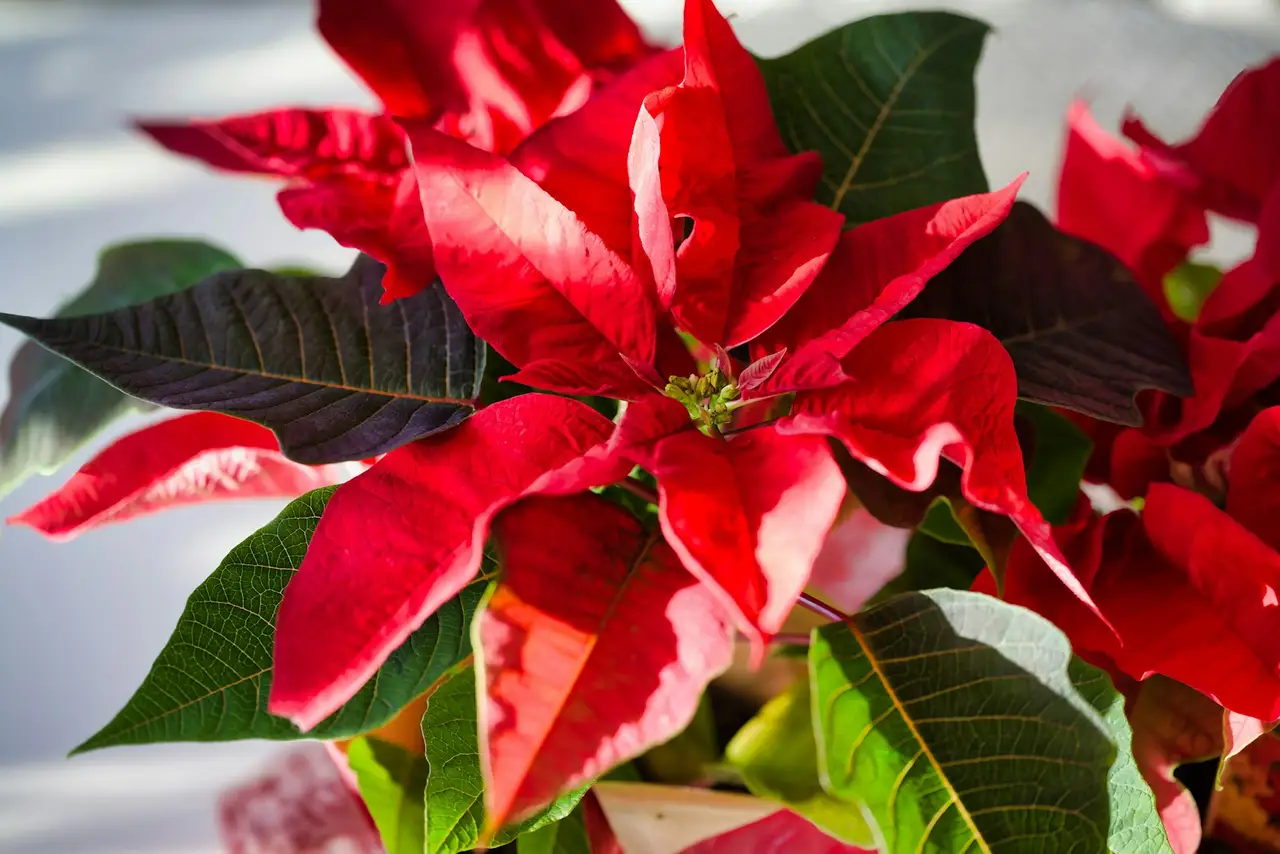
- Treating “the red parts” differently from the green parts. The bracts (red leaves) contain the same sap. There’s nothing special about the colored portion that makes it more or less dangerous.
- Worrying about cut poinsettias in floral arrangements differently. Same toxicity. The amount of plant material your cat can reach from a stem in a vase is usually less than from a potted plant, but the per-bite toxicity is identical.
FAQ
What part of the poinsettia is poisonous to cats?
The milky white sap in the leaves and stems is the irritant. The colored bracts (the red parts most people think of as petals) are modified leaves that contain the same sap. Pet Poison Helpline classifies the toxicity as mild.
How much poinsettia does a cat have to eat to get sick?
A single nibbled leaf rarely causes more than brief drooling or one episode of vomiting. Purdue Agriculture notes that poinsettias are not harmful to household pets unless the leaves and bracts are eaten in very large quantities, which is hard for a cat to do given the bitter sap.
How long does poinsettia poisoning last in cats?
Usually 12 to 24 hours. Pet Poison Helpline notes the signs are self-limiting and typically don’t require medical treatment unless severe and persistent.
Will my cat die from eating a poinsettia?
Almost never. The ASPCA describes poinsettia toxicity as “generally over-rated.” The story that poinsettias are deadly to cats is a long-standing myth that veterinary toxicology has debunked. Genuinely deadly holiday plants are lilies, mistletoe, and yew, not poinsettias.
Is the red part of the poinsettia toxic to cats?
The red “flowers” are technically colored bracts (modified leaves) and contain the same milky sap as the green leaves. They carry the same mild toxicity, not more.
Are poinsettias toxic to kittens?
The toxicity profile is the same, but smaller body weight means a smaller dose can cause symptoms. A kitten that eats a poinsettia leaf should be watched more closely than an adult cat, and any vomiting that lasts more than a few hours warrants a vet call.
The takeaway
The poinsettia myth is one of the cleanest examples of how pet-safety information gets distorted: a single 1944 case report became a century of folk wisdom that veterinary toxicology has spent 80 years correcting. If you came here mid-panic because your cat just chewed on a poinsettia leaf, you can stop panicking. Monitor for 12 to 24 hours, keep the plant out of reach, and call your vet if symptoms persist or worsen. The plant is fine. The cat is fine. The holiday is fine.
If you want to swap in something truly cat-safe for next year’s decorations, our cat-safe flowers guide lists 8 ASPCA-verified options that work for centerpieces and gift arrangements, and our cat-safe plants pillar covers the houseplants that get year-round duty.
Emergency phone numbers
Keep these somewhere visible in any cat household:
- ASPCA Animal Poison Control: (888) 426-4435 (a consultation fee may apply)
- Pet Poison Helpline: (855) 764-7661 (a consultation fee applies)
Both lines are open 24/7 and staffed by veterinary toxicologists.
Sources cited
- ASPCA. Toxic and Non-toxic Plants: Poinsettia. Verified May 18, 2026.
- Pet Poison Helpline. Poinsettia toxin entry. Verified May 18, 2026.
- Purdue University Agriculture, Plant and Pest Diagnostic Lab. Poinsettia Plant: Is it Poisonous to Pets?. Lerner, R., Creswell, T., and Ruhl, G. Verified May 18, 2026.
- Washington State University, Veterinary Teaching Hospital. Holiday health hazards for pets. Verified May 18, 2026.
- New York Botanical Garden. Dispelling a Seasonal Myth: For Humans, The Poinsettia is Not a Toxic Plant. Balick, M. J., and Nelson, L. S. December 12, 2019. Verified May 18, 2026.