You searched “is bamboo toxic to cats” because your cat is chewing on something with bamboo in the name. Here is the short version: true bamboo is not toxic to cats. The ASPCA lists bamboo as non-toxic to cats, dogs, and horses. The trouble is that the two “bamboos” most people actually own are not bamboo at all, and both are toxic.
The desk plant in a vase of water is lucky bamboo, a Dracaena. The garden shrub with red winter berries is heavenly bamboo, a Nandina. This guide tells you which one you have, how worried to be about each (the answer is very different), and what to do if your cat has already taken a bite.
Is bamboo toxic to cats? The quick answer
No. True bamboo, a grass, is non-toxic to cats per the ASPCA, and so are bamboo palm and bamboo vine. But lucky bamboo (Dracaena sanderiana) and heavenly bamboo (Nandina domestica) are not true bamboo, and the ASPCA lists both as toxic to cats. Lucky bamboo causes mild-to-moderate stomach upset; heavenly bamboo releases cyanide and is the one to take seriously.
TL;DR
- True bamboo: safe. The ASPCA lists golden bamboo (Phyllostachys aurea) as non-toxic to cats. A cat that chews it may vomit a mouthful of leaf, and that is the whole event.
- Lucky bamboo: toxic, mild. It is a Dracaena. Saponins cause drooling, vomiting, loss of appetite, and dilated pupils in cats. NC State Extension rates it low severity.
- Heavenly bamboo (nandina, sacred bamboo): toxic, serious. Cyanogenic glycosides. Call a vet or poison hotline if your cat ate any of it, berries especially.
- Bamboo palm: safe. It is a palm (Chamaedorea), listed non-toxic by the ASPCA.
- You can tell them apart in 30 seconds: water and curly stalks means lucky bamboo; red berries and lacy leaves means nandina; hollow woody canes means true bamboo.
- Hotlines (24/7, fee applies): Pet Poison Helpline 855-764-7661, ASPCA Animal Poison Control 888-426-4435.
Every bamboo-named plant, checked against the ASPCA
We searched the ASPCA’s toxic and non-toxic plant list for cats for every entry with “bamboo” in a name and every plant commonly sold as bamboo. Each verdict links to the entry we read.
| Sold as | Scientific name | Verdict for cats | ASPCA entry | What it means |
|---|---|---|---|---|
| Bamboo, golden bamboo, fishpole bamboo | Phyllostachys aurea | Non-toxic | Bamboo | A true bamboo; no clinical signs listed |
| Bamboo palm, reed palm, parlor palm | Chamaedorea | Non-toxic | Bamboo Palm, Reed Palm | A palm, not a bamboo; safe |
| Bamboo vine, laurel-leaved greenbrier | Smilax laurifolia | Non-toxic | Bamboo Vine | A climbing vine; safe |
| Red-berried bamboo, red-berried greenbrier | Smilax walteri (listed as walteria) | Non-toxic, with a caveat | Red Berried Greenbrier | Entry notes possible vomiting, diarrhea, depression; “low toxicity” |
| Lucky bamboo, ribbon plant, corn plant, dragon tree | Dracaena spp. (lucky bamboo is D. sanderiana) | Toxic | Dracaena, Ribbon Plant | Saponins; stomach upset, dilated pupils |
| Heavenly bamboo, sacred bamboo, nandina | Nandina domestica | Toxic | Heavenly Bamboo, Nandina | Cyanogenic glycosides; the serious one |
Two filing quirks explain most of the bad information online. First, the ASPCA has no entry under the name “lucky bamboo.” It sits inside the genus-wide Dracaena entry, so a search for the common name comes up empty, and people conclude it must be fine. Pet Poison Helpline’s Dracaena page closes the gap by listing Lucky Bamboo as an alternate name outright.
Second, “ribbon plant” is an ASPCA name for two different plants: the toxic Dracaena and the non-toxic spider plant (Chlorophytum comosum). If a tag says only “ribbon plant,” check the Latin name before you trust a verdict.
Why true bamboo is safe and the “bamboos” are not
True bamboo is a grass. NC State Extension describes golden bamboo as an evergreen member of the grass family that typically reaches 10 to 20 feet, with hollow canes that turn yellow as they mature. The ASPCA entry for it lists no toxic principle and no clinical signs.
One honest limit: that entry names one species. Black bamboo, clumping Bambusa species, and the dozens of other true bamboos sold for gardens have no individual ASPCA entries. They are grasses in the same subfamily, and the ASPCA lists no true bamboo as toxic, so the reasonable reading is low risk. But the verified verdict belongs to golden bamboo, and we will not stretch it further than that.
The two impostors got the name because they look a little like bamboo, and their chemistry is unrelated to grass and to each other. That is why lumping their symptoms into one list, which several pages do, misleads readers in both directions. Lucky bamboo can sound like it causes seizures (it does not), and nandina can sound like a tummy ache (it is more than that).
Is lucky bamboo toxic to cats?
Yes. Lucky bamboo is toxic to cats, and it is the bamboo you are most likely to have indoors. NC State Extension is blunt about the name: “Lucky bamboo is not a bamboo at all.” It is Dracaena sanderiana (previously Dracaena braunii), a tropical shrub from West Africa in the asparagus family.
The ASPCA’s Dracaena entry lists the genus as toxic to dogs and cats, with saponins as the toxic principle. Pet Poison Helpline places the saponins in the leaves and stems; NC State lists every part of the plant, roots included.
This is the same chemistry as the snake plant, which taxonomists now classify as Dracaena trifasciata. If you have read our guide to whether snake plants are toxic to cats, the picture here is the same: saponins irritate the gut, and the signs are mostly gastrointestinal.
Lucky bamboo symptoms in cats and how serious they are
The ASPCA’s listed clinical signs for Dracaena, quoted exactly: “Vomiting (occasionally with blood), depression, anorexia, hypersalivation, dilated pupils (cats).” In plain terms, that means vomiting, a quiet or withdrawn cat, loss of appetite, and drooling. Pet Poison Helpline lists drooling and vomiting, and notes “dilated pupils and wobbly gait reported specifically in cats.”
The dilated pupils catch people off guard, because they look neurological and frightening. Both databases list them as a cat-specific sign of Dracaena exposure, so on their own they do not mean something worse is happening. Pair them with unsteady walking, though, and it is time to call.
Calibrate it correctly. NC State rates lucky bamboo’s poison severity as low, and neither the ASPCA nor Pet Poison Helpline lists organ damage among its signs. This is not a lily. Neither database publishes an hour-by-hour timeline for Dracaena, so we will not invent one. Watch your cat closely for the rest of the day, and use the call-your-vet thresholds below.
Is heavenly bamboo (nandina) toxic to cats?
Yes, and this is the bamboo-named plant to take seriously. Heavenly bamboo, sold as sacred bamboo or nandina, is Nandina domestica, an evergreen shrub in the barberry family. The ASPCA’s Heavenly Bamboo entry lists it as toxic to dogs, cats, and horses. The toxic principle is cyanogenic glycosides, and the listed signs are “Weakness, incoordination, seizures, coma, respiratory failure, death (rare in pets).”
Pet Poison Helpline’s heavenly bamboo page explains the mechanism: all parts may contain cyanide-producing compounds, and chewing or damaging the plant releases free cyanide. NC State rates its poison severity high and lists the fruits, leaves, and stems as the toxic parts.
Here is the calibration. The chemistry is genuinely dangerous, but documented serious poisonings come mostly from animals that eat a lot of it. Pet Poison Helpline notes the risk is higher in livestock that eat large amounts than in pets that eat small amounts. The best-known case involved birds: in 2009, dozens of cedar waxwings in Georgia died after gorging on the berries, and their necropsy findings were consistent with cyanide toxicity, as reported by Woldemeskel and Styer in Veterinary Medicine International.
A cat is unlikely to eat a shrub’s worth of berries. But “rare in pets” is not “safe,” and there is no watch-and-wait version of a cyanide plant. If your cat ate any part of a nandina, call.
Nandina is almost always an outdoor landscape shrub, so this is mainly a concern for indoor-outdoor cats, and for anyone who brings the berried branches indoors as winter decor.
Which bamboo do you have? A 30-second identification guide
Work down this list. The first match is your plant.
- Is it growing in a vase of water or pebbles, with smooth, fleshy green stalks that are curled, braided, or tied in tiers, often with a gold or red ribbon? That is lucky bamboo (toxic, mild). NC State describes the stem as a “thick green fleshy stem resembling bamboo” with strappy leaves spaced along it. It is usually sold as a desk or gift plant.
- Is it a shrub with lacy, layered leaves that turn red or bronze, and clusters of bright red berries in fall and winter? That is heavenly bamboo / nandina (toxic, serious). NC State describes compound leaves that are red to bronze in spring and purplish-red in fall, and red berries about 8 mm across that persist through winter.
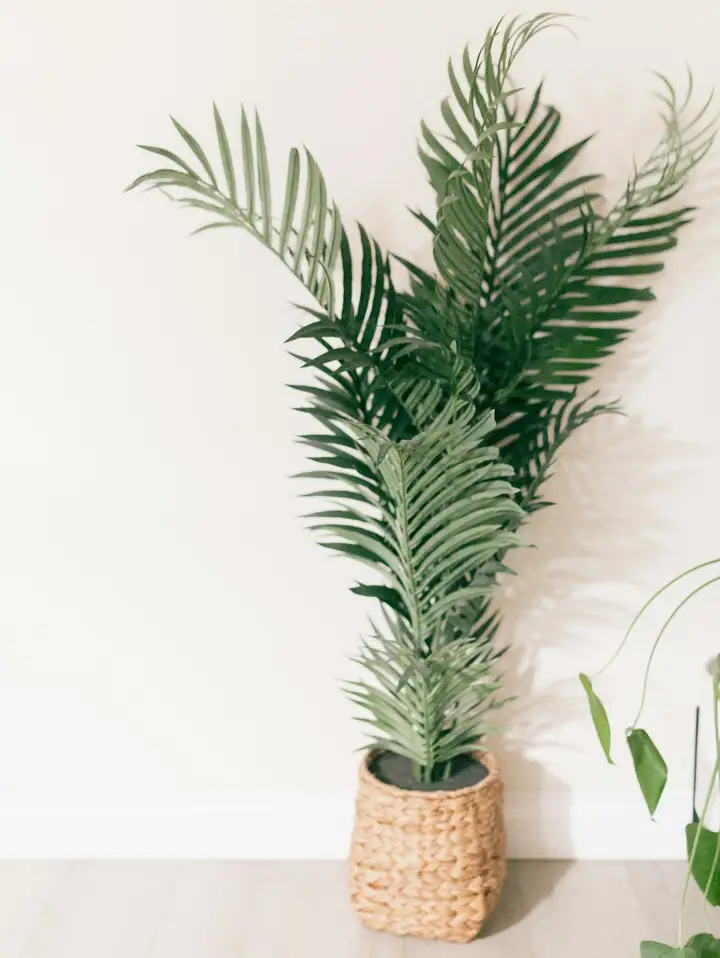
- Is it a palm with feathery fronds on slim, clustered green canes, sold as a floor plant? That is a bamboo palm (non-toxic). NC State notes these canes have “prominent nodes like bamboo,” which is where the name comes from.
- Does it have hollow, woody, segmented canes with grassy leaves, and is it sold as a garden or screening plant? That is true bamboo (non-toxic for golden bamboo, low risk for its unlisted relatives).
Still unsure? Cut nothing, and photograph the plant, the stem, and any tag. The Latin name on a nursery tag settles it: Dracaena and Nandina are toxic; Phyllostachys and Chamaedorea are not.
What to do if your cat ate bamboo
Start by identifying the plant with the guide above, because the right response depends entirely on which one it was. In every scenario, the two hotlines answer 24/7: Pet Poison Helpline at 855-764-7661 and ASPCA Animal Poison Control at 888-426-4435 (a consultation fee applies to both).
If it was true bamboo or a bamboo palm
Most likely nothing will happen. A cat may bring back a mouthful of leaves a few minutes later, which is a stomach dealing with fibrous plant material, the same as with grass. The ASPCA lists no clinical signs for these plants. Offer water and carry on. Call your vet only if vomiting repeats over several hours, your cat stops eating, or you are not sure what the plant was.
If it was lucky bamboo
- Take any plant pieces out of your cat’s mouth and move the plant to a room the cat cannot get into.
- Offer fresh water.
- Do not try to make your cat vomit unless a vet tells you to.
- Watch for the listed signs: drooling, vomiting, loss of appetite, a subdued cat, dilated pupils, unsteady walking.
Call your vet or a hotline if your cat vomits more than once or twice, you see blood in the vomit (the ASPCA notes it can happen), your cat is wobbly or unusually weak, it refuses food for the rest of the day, or it is a kitten, a senior, or already unwell. Call too if you have no idea how much was eaten.
If it was heavenly bamboo (nandina)
Call a vet or hotline now, before any signs appear. Tell them it was Nandina domestica, which part (berries, leaves, stems), roughly how much, and when. Bring a photo or a sprig with you if you go in. This is the only scenario on this page where you should not wait to see what happens.
Why cats chew bamboo, and how to stop them
Look at a lucky bamboo leaf next to a blade of cat grass and the attraction is obvious: long, thin, strappy, and fibrous. Lucky bamboo also tends to live at exactly cat height, on a desk or windowsill, in an open vase of water that doubles as a drinking fountain.
What works, in order of how much it helps:
- Move it or lose it. Lucky bamboo is toxic in every part, so the reliable fix is a room with a door, a high shelf with no launch point nearby, or rehoming it. Our guide to cat-safe indoor trees covers floor plants that do not need guarding.
- Close the water. If you keep lucky bamboo, use a narrow-neck vase or a covered planter so the vase stops being a water bowl.
- Give the chewing somewhere to go. A pot of cat grass near the cat’s favorite spot is the single best redirect for grass-chewers.
- Use deterrents that are safe for cats. Barriers and placement come first, and anything you spray needs to be safe for a cat to lick. Our guide on how to keep cats away from plants covers what works and what does not.
Cat-safe alternatives to lucky bamboo
If you want the bamboo look without the Dracaena, these are ASPCA-verified:
- Bamboo palm or parlor palm (Chamaedorea, ASPCA entry). Slim, cane-like stems with nodes, feathery fronds, and medium light tolerance. The closest look to bamboo indoors. One footnote: NC State notes the fruit flesh of the retail bamboo palm (C. seifrizii) can irritate sensitive human skin, so wear gloves if yours ever fruits.
- Spider plant (Chlorophytum comosum, ASPCA entry). The same strappy, arching leaves, and non-toxic to cats and dogs.
- Cat grass. Not a decor plant, but it gives a bamboo-chewing cat the texture it was looking for, and it is meant to be eaten.
- Golden bamboo, outdoors. It is non-toxic, but NC State lists it as invasive and notes it spreads aggressively, so plant it only in a container or a properly contained bed.
Most local nurseries stock bamboo palms and spider plants, and online retailers such as The Sill and Bloomscape sell parlor palms in pots. Whatever you buy, read the Latin name on the tag.
What to skip
- Do not trust the word “bamboo” on a label. Two of the three plants most people call bamboo are toxic. The Latin name is the only reliable check.
- Do not assume a missing ASPCA result means safe. “Lucky bamboo” returns nothing on the ASPCA site because it is filed under Dracaena, which is toxic.
- Do not panic over a chewed lucky bamboo leaf. It is a low-severity plant. Watch your cat and use the thresholds above.
- Do not wait and see with nandina. It is the one bamboo-named plant where you call first.
- Do not use garlic, onion, or essential-oil sprays as deterrents. Some popular “keep cats off plants” tips recommend garlic paste, and the ASPCA lists garlic itself as toxic to cats. Concentrated essential oils are a hazard of their own, as our article on whether peppermint oil is safe for cats explains.
- Do not believe lists that call money tree a Dracaena. The ASPCA’s Money Tree entry is Pachira aquatica, a different plant, and it is non-toxic.
Frequently asked questions
Is bamboo toxic to cats? No. The ASPCA lists true bamboo (Phyllostachys aurea, golden or fishpole bamboo) as non-toxic to cats, dogs, and horses. Lucky bamboo (a Dracaena) and heavenly bamboo (Nandina domestica) are not true bamboo, and both are toxic to cats.
Is lucky bamboo toxic to cats? Yes. Lucky bamboo is Dracaena sanderiana, and the ASPCA lists Dracaena as toxic to cats. Saponins cause vomiting (occasionally with blood), drooling, loss of appetite, depression, and dilated pupils in cats; Pet Poison Helpline adds a wobbly gait. NC State rates it low severity. Call your vet if vomiting repeats or your cat is unsteady.
Is bamboo safe in a house with cats? True bamboo and bamboo palm are safe; the ASPCA lists both as non-toxic. Lucky bamboo is toxic and belongs out of reach or out of the house. Heavenly bamboo is an outdoor shrub and the most dangerous plant called bamboo.
Why does my cat eat my bamboo plant? The long, thin, fibrous leaves feel like grass, and lucky bamboo usually sits at cat height in an open vase of water. Move the toxic kind out of reach and offer a pot of cat grass as the approved alternative.
What is the difference between lucky bamboo and regular bamboo? Regular bamboo is a woody grass with hollow, segmented canes that grows 10 to 20 feet outdoors. Lucky bamboo is a West African Dracaena in the asparagus family with fleshy green stems, usually sold in water or pebbles. Regular bamboo is non-toxic to cats; lucky bamboo is toxic.
Are Dracaena safe for cats? No. The ASPCA lists the whole Dracaena genus as toxic to cats and dogs, including corn plant, dragon tree, ribbon plant, and lucky bamboo. The signs are mostly gastrointestinal, plus dilated pupils in cats. Snake plant (Dracaena trifasciata) shares the same saponin chemistry.
Is heavenly bamboo toxic to cats? Yes. The ASPCA lists Nandina domestica as toxic to cats, dogs, and horses because of cyanogenic glycosides, with weakness, incoordination, seizures, coma, respiratory failure, and death (rare in pets) as the listed signs. If your cat ate any part, call a vet or hotline right away.
My cat drank the water from my lucky bamboo vase. Is that dangerous? No source we trust addresses the vase water specifically. The roots sit in it and NC State lists roots among the toxic parts, so treat regular drinking as an exposure to stop rather than an emergency. Watch for vomiting or drooling, cover or move the vase, and call your vet if signs appear.
Related articles
- Are Snake Plants Toxic to Cats?, the other popular Dracaena, with the same saponins as lucky bamboo
- Cat-Safe Indoor Trees, including the bamboo palm and the Dracaena floor plants to avoid
- Spider Plant and Cats, the safe “ribbon plant” with the same strappy leaves
- Are Ferns Toxic to Cats?, another plant family where the safe genus has toxic impostors
- Are Lilies Toxic to Cats?, the plant that belongs in the true emergency tier
- Cat-Safe Houseplants, our master list of ASPCA-verified non-toxic plants
Sources
Every verdict above was checked against the linked page on 2026-10-06.
- ASPCA: Toxic and Non-Toxic Plant List for Cats
- ASPCA non-toxic entries: Bamboo, Bamboo Palm, Reed Palm, Bamboo Vine, Red Berried Greenbrier, Spider Plant, Money Tree
- ASPCA toxic entries: Dracaena, Ribbon Plant, Heavenly Bamboo, Sacred Bamboo, Nandina, Garlic
- Pet Poison Helpline: Dracaena, Heavenly Bamboo; 855-764-7661, 24/7
- NC State Extension Gardener Plant Toolbox: Dracaena sanderiana, Nandina domestica, Phyllostachys aurea, Chamaedorea seifrizii
- Woldemeskel M, Styer EL. Feeding Behavior-Related Toxicity due to Nandina domestica in Cedar Waxwings (Bombycilla cedrorum). Veterinary Medicine International, 2010.
The rule that survives all the species detail: real bamboo is a grass and your cat is fine. Check for water and curly stalks (lucky bamboo: move it, watch your cat) or red berries on a shrub (nandina: call now), and you will know which situation you are in.