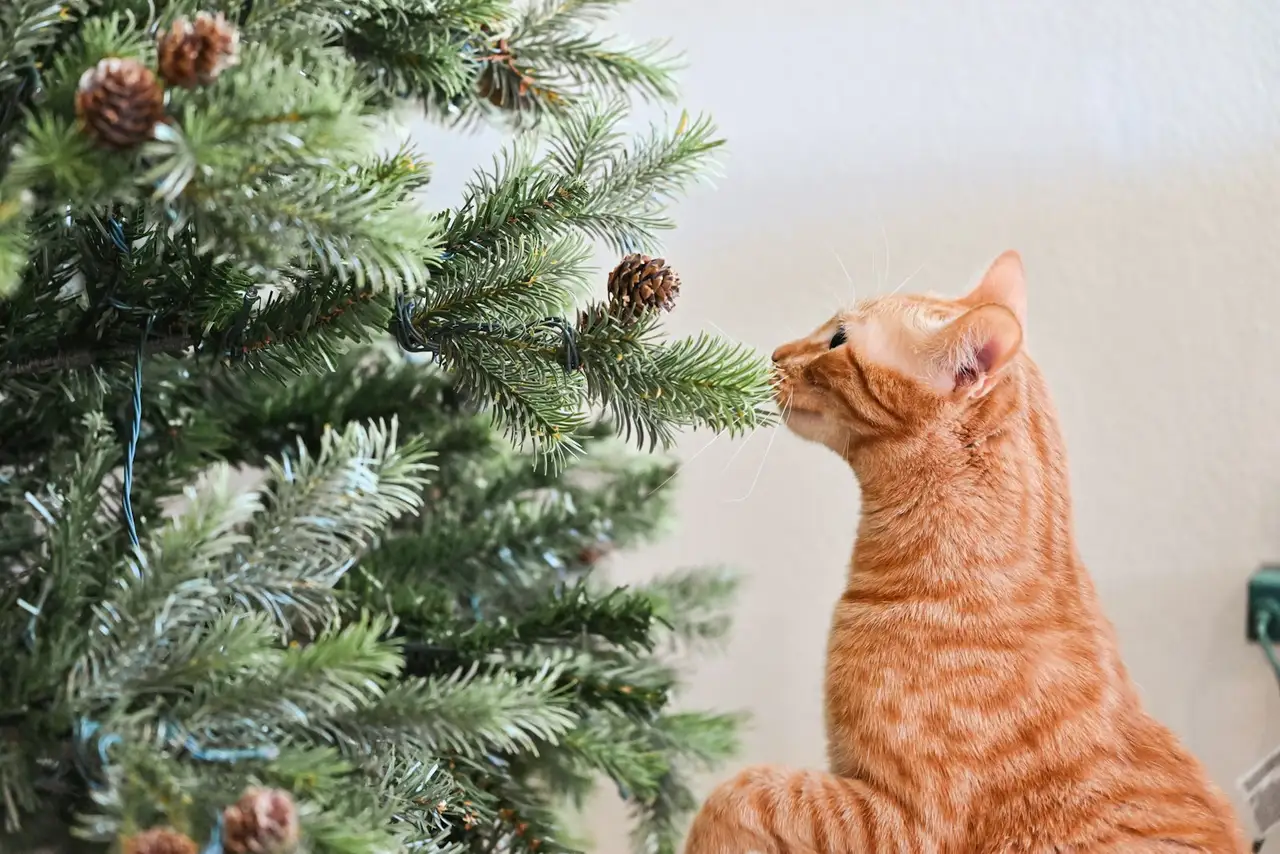
Are Christmas trees toxic to cats? Only mildly. Fir, spruce, and pine needles can irritate a cat’s mouth and stomach, and Pet Poison Helpline’s veterinarians list nausea, vomiting, skin irritation, or injury to the stomach as the possible effects. Serious poisoning from the tree itself is not the realistic risk. The things you hang on it and pour into its stand are.
If your cat just chewed a few needles, you are almost certainly looking at some drooling or one episode of vomiting, not an emergency. If your cat swallowed tinsel or bit through a light cord, that is a different situation, and the steps are further down this page.
TL;DR
- The tree is mildly irritating, not poisonous. Needles, sap, and tree water can cause nausea, vomiting, and skin irritation (Pet Poison Helpline). Sharp needles are mainly a mechanical risk to the mouth and gut.
- The ASPCA has no entry for fir, spruce, or Douglas fir, the trees most people buy. The pines it does list (Ponderosa pine, and Norfolk Island pine, which is not a true pine) are non-toxic to cats.
- Tinsel and ribbon are the most dangerous things on the tree. A swallowed strand can saw through the intestine and needs surgery.
- Chewed light cords can cause burns, breathing trouble, and abnormal heart rhythm (WSU College of Veterinary Medicine).
- Use plain water in the stand and cover it. Commercial preservatives are usually only a stomach-upset risk; homemade recipes with aspirin or bleach are worse.
- Pine oil is not pine needles. Concentrated pine essential oil is highly toxic to cats. Skip pine-scented sprays and diffusers.
- Watch the greenery, not just the tree. Yew in wreaths is the genuinely dangerous evergreen. Holly and mistletoe are toxic too.
- The safe living trees: Norfolk Island pine and rosemary topiary, both ASPCA non-toxic.
Are Christmas trees toxic to cats?
Christmas trees are mildly toxic to cats at most. The common species (fir, spruce, Douglas fir, Scotch pine) have no entry in the ASPCA’s toxic plant database. Veterinary sources describe their needles, sap, and stand water as causing mouth irritation, nausea, and vomiting, plus a mechanical risk from sharp needles. Serious poisoning is unlikely.
We checked every conifer and holiday-greenery entry in the ASPCA’s list of plants toxic and non-toxic to cats, scanning all 983 rows by scientific name. Here is what it actually says about the trees you are likely to bring home.
| Tree or greenery | Scientific name | ASPCA status for cats | What it means in practice |
|---|---|---|---|
| Fraser, balsam, Nordmann, noble fir | Abies spp. | No entry | Mild mouth and stomach irritation; needles are the main risk |
| Douglas fir | Pseudotsuga menziesii | No entry | Same as true firs |
| Norway, blue, white spruce | Picea spp. | No entry | Same, with the sharpest needles of the group |
| Scotch pine, white pine | Pinus sylvestris, P. strobus | No entry | Same; long needles, more sap |
| Ponderosa pine | Pinus ponderosa | Non-toxic (listed as Blackjack Pine) | Rarely sold as a cut tree |
| Norfolk Island pine | Araucaria heterophylla | Non-toxic (listed as Australian Pine) | The cat-safe living tree |
| Rosemary topiary | Rosmarinus officinalis | Non-toxic | The cat-safe tabletop tree |
| Yew (wreaths, garlands) | Taxus spp. | Toxic | Can cause sudden heart failure; keep out of the house |
| Buddhist pine, yew pine | Podocarpus macrophylla | Toxic | Vomiting and diarrhea |
| Holly | Ilex spp. | Toxic | Vomiting, diarrhea; ASPCA calls leaves and berries low toxicity |
| American mistletoe | Phoradendron flavescens | Toxic | Vomiting, diarrhea, slow heart rate, rarely low blood pressure |
“No entry” does not mean “proven safe.” It means the database the rest of the internet quotes has never classified these trees, so anyone telling you “fir is toxic” or “spruce is safer than pine” is not quoting the ASPCA. The honest summary comes from the veterinary sources that have addressed the trees directly, and they agree: mild irritation plus a needle problem.
Are pine trees and pine needles toxic to cats?
Pine needles are mildly irritating to cats, not poisonous in the usual sense. VCA Animal Hospitals says pine needles “can cause skin irritation, nausea and intestinal obstruction.” Note the third item: the needle’s shape is as much of a concern as its chemistry, because stiff needles do not break down well in the gut.
The one pine the ASPCA classifies, Ponderosa pine, is listed as non-toxic to cats, dogs, and horses. Its entry names a toxic principle (isocupressic acid), but the only clinical sign listed is “abortions in cattle (not seen in other species).” That is a livestock problem, not a cat problem.
Are fir and spruce trees toxic to cats?
Neither genus has an ASPCA entry, and no veterinary source we found ranks fir or spruce as safer or more dangerous than pine. The practical differences are physical. Spruce needles are typically stiff and sharp, which makes them more irritating if chewed or swallowed. Many firs have softer needles and hold them longer, which means fewer loose needles on the floor. PetMD’s veterinarian-written guide suggests a low-drop tree such as a Nordmann fir for exactly that reason.
Are artificial Christmas trees safer for cats?
An artificial tree removes the sap, the needle oils, and the water dish, which are three of the five hazards on this page. It does not remove the chewing problem. PetMD notes that chewed plastic or aluminum needles can still irritate the mouth and cause an intestinal blockage if pieces are swallowed. A fake tree is the lower-risk choice, not a no-risk one.
Why Christmas tree needles upset a cat’s stomach
Two things happen when a cat chews a conifer. First, the oils and sap in the needles irritate the lining of the mouth and stomach, which produces drooling, lip-licking, and sometimes vomiting. Pet Poison Helpline adds that “cats are very sensitive [to] the pine oils and chronic ingestions could cause problems,” which is the case for stopping a daily chewing habit even when one nibble is harmless.
Second, the needles themselves are sharp, stiff, and hard to digest. A few pass through without trouble. A mouthful can scratch the throat or contribute to a blockage. That mechanical risk is why a cat that vomits repeatedly or stops eating after chewing the tree needs a vet, even though the tree is not “toxic” in the dramatic sense.
Sap on fur is a sneaky third route. Pet Poison Helpline’s advice: if you see or feel sap on your cat’s coat, wash it off right away, because your cat will otherwise lick it off and swallow it.
Pine needles vs pine oil: not the same risk
This is where a lot of holiday content goes wrong. Several articles list tremors, low body temperature, and liver failure as signs of “pine needle poisoning.” Those signs belong to concentrated pine essential oil, a completely different exposure.
Pet Poison Helpline’s pine oil page describes pine oil as “highly toxic when ingested” and says “cats are especially sensitive to this product.” Small volumes of the concentrated oil can cause severe stomach injury, seizures, organ failure, and death. A cat chewing a branch gets a tiny amount of oil bound up in plant tissue. A cat that licks spilled pine oil, walks through a floor washed with a pine-oil cleaner, or grooms after brushing against a sprayed tree gets a dose of the concentrate.
So the needle risk is mild, and the pine-scented products around the tree are the real pine toxicity hazard. The same mechanism makes other essential oils risky, which we cover in is peppermint oil safe for cats.
The real Christmas tree dangers for cats, ranked
Ranked by how bad the worst realistic outcome is, the tree itself comes last.
- Tinsel, ribbon, and garland. Washington State University’s veterinary hospital explains the mechanism: one end gets stuck while the intestine pulls the rest along, and the contractions can make the strand “saw through the intestine.” Signs include vomiting, diarrhea, depression, belly pain, and fever. Pet Poison Helpline adds that cats with this kind of obstruction often keep eating and drinking for a while, which delays the diagnosis. Its tinsel page also notes some tinsel contains zinc, which can cause anemia.
- Light cords. WSU lists burns, difficulty breathing, abnormal heart rhythm, loss of consciousness, and death as possible results of electrical shock. Pet Poison Helpline notes that cats who bite a live cord often have difficulty breathing and burns in the mouth.
- Tree water. Covered in detail below. Usually a stomach-upset problem, sometimes worse depending on what you added.
- Tip-overs and broken ornaments. A climbing cat can bring down a tree, and glass ornaments can cut paws and mouths.
- Needles and sap. Mild irritation plus the mechanical risk described above.
Is Christmas tree water toxic to cats?
Plain tree water is mostly a hygiene problem: VCA notes it can contain fertilizers, pine oils, and bacteria that cause stomach upset. Additives change the picture, but less than you might expect for commercial products.
The National Capital Poison Center says commercial tree preservatives typically contain fertilizer, sugar, and sometimes fungicides, and that the amounts children, cats, and dogs usually drink are not poisonous, though some stomach upset and vomiting can happen. The homemade recipes are the concern: they can include aspirin (which the center notes is not safe for many pets), bleach, and alcohol. The same page reports that professional tree farmers recommend plain tap water anyway.
The fix is simple: plain water only, and a covered stand. A tree skirt that closes over the reservoir, or a stand with a built-in cover, keeps a curious cat from treating it as a novelty water bowl.
What is the safest Christmas tree for cats?
The safest Christmas tree for cats is a living Norfolk Island pine. It is not a true pine (it belongs to the Araucaria family), the ASPCA lists it as non-toxic to cats, dogs, and horses, and its soft, layered branches take light ornaments well. It also outlasts the season as a houseplant. Our guide to cat-safe indoor trees covers its light and humidity needs.
Your other options, in order of overall risk:
- Rosemary topiary. Grocery stores and garden centers sell rosemary trained into a small cone every November. The ASPCA lists rosemary as non-toxic to cats, and it is one of the herbs we note in our basil and cat-safe herbs guide as safe to nibble.
- Artificial tree. No sap, no oils, no water dish. Discourage chewing, and skip scent sprays.
- Cut fir or spruce, set up carefully. Perfectly reasonable for most households if you use plain water, cover the stand, sweep needles daily, and follow the cat-proofing steps below.
- Tabletop or wall-mounted tree. A small tree on a high, stable surface, or a flat “tree” of lights and ornaments mounted on the wall, removes the climbing problem entirely. A good choice for kittens.
How to cat-proof your Christmas tree
These steps come from VCA, Pet Poison Helpline, WSU, and the cat-behavior advice in Hill’s guide to cats and Christmas trees. They work best set up before the tree goes in, since the first few days are when curiosity peaks.
- Anchor the tree at the top and bottom. Pet Poison Helpline recommends securing both. A heavy stand handles the base; fishing line tied to an eye hook in the wall or ceiling handles the top.
- Clear the launch pads. Move chairs, side tables, and shelves away from the tree so your cat cannot jump into it from above.
- Cover the water. Use a covered stand or a tree skirt that closes over the reservoir, and add nothing but plain water.
- Wrap the lights inward. Run strands deep along the branches rather than draping them on the tips, cover the cord to the outlet, and check it for bite marks every few days. WSU recommends grounded three-prong extension cords. Unplug the tree when nobody is home.
- Skip tinsel entirely. Of all the decorations, tinsel is the one where a single strand can mean surgery.
- Hang ornaments high and fasten them. Keep the bottom third of the tree bare or decorated with unbreakable ornaments. Twist ties or closed hooks hold ornaments far better than open wire hooks a paw can flick off.
- Make the base unpleasant. Aluminum foil or double-sided tape around the stand discourages most cats. Our guide to keeping cats away from plants covers more deterrents that work on a tree as well as on houseplants.
- Sweep needles daily. Fallen needles on the floor are the ones cats actually eat.
- Close the door when you leave. If the tree is in a room you can shut, that is the most reliable protection of all.
Giving your cat something better to chew helps too. A pot of cat grass near the tree gives a needle-chewer a safe target.
Holiday greenery to skip: yew, holly, mistletoe, and “pines” that aren’t
The plants around the tree deserve more attention than the tree. These are the ones to keep out of a cat household, or at least out of reach.
- Yew (Taxus species). The one evergreen on this page that is genuinely dangerous. The ASPCA lists taxine as the toxic principle and “sudden death from acute cardiac failure” among the clinical signs; its Japanese yew entry adds tremors, difficulty breathing, and vomiting. Yew is a common landscaping shrub, so its clippings end up in homemade wreaths and garlands. If you make your own greenery, know what you cut.
- Buddhist pine, or yew pine (Podocarpus macrophylla). Sold as a houseplant and bonsai, and not a pine at all. The ASPCA lists it as toxic, with vomiting and diarrhea. This is the name trap in reverse: Norfolk Island pine is a “pine” that is safe, and Buddhist pine is a “pine” that is not.
- Holly (Ilex species). Toxic per the ASPCA, with vomiting, diarrhea, and depression, though its entry notes that leaves and berries are low toxicity.
- Mistletoe. The ASPCA lists American mistletoe as toxic, with vomiting, diarrhea, difficulty breathing, a slow heart rate, and (rarely) low blood pressure. WSU advises seeking veterinary advice right away if your pet eats any part of it. Artificial mistletoe solves this completely.
- Eucalyptus in modern garlands. Silver-dollar eucalyptus has become a standard in holiday swags and is toxic to cats; see is eucalyptus safe for cats.
- Lilies in holiday bouquets. Not greenery, but they show up in December arrangements and are the one plant in this category that can cause kidney failure in cats. See our lily emergency guide.
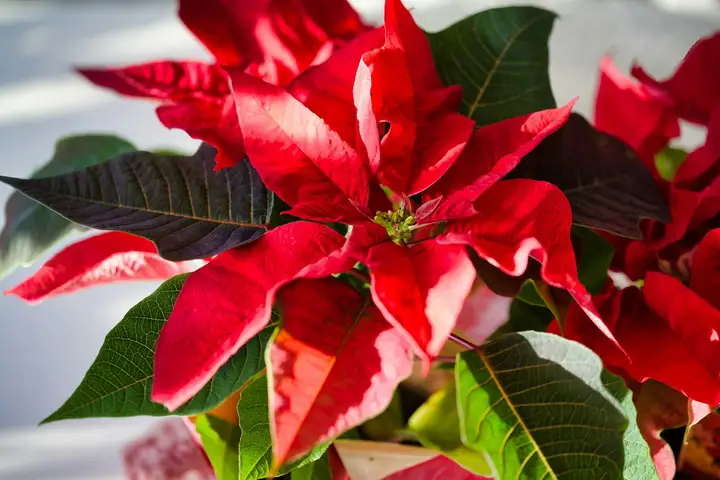
Two holiday plants worry people more than they should. Poinsettias are only mildly toxic, as we explain in are poinsettias poisonous to cats, and Christmas cactus is non-toxic to cats per the ASPCA. One more name trap: the ASPCA lists the hemlock tree (Tsuga) as non-toxic, which has nothing to do with poison hemlock, a toxic weed in the carrot family.
What to do if your cat ate pine needles, tinsel, or tree water
Match what happened to the right response.
Your cat chewed a few needles or drank from the stand.
- Remove any needles or plant material from the mouth if your cat lets you.
- Wash off any sap on the fur so it does not get licked off later.
- Offer fresh water and watch for the rest of the day.
- Expect, at most, drooling or a single episode of vomiting.
- Call your vet if your cat vomits repeatedly, refuses food, seems lethargic, or strains in the litter box. Those point to irritation or a blockage that needs an exam. If you added aspirin, bleach, or anything homemade to the water, call a poison line now rather than waiting.
Your cat swallowed tinsel, ribbon, or string.
Call your vet now, even if your cat seems fine, since these cats often keep eating at first. If you can see a strand hanging from the mouth or the rear end, do not pull it. VCA and Pet Poison Helpline’s veterinarians, writing in dvm360, both warn that pulling can cause further tissue damage. Only a veterinary team should remove it. Your cat bit a light cord.
Unplug the cord before you touch your cat. Then check the mouth for burns and the whiskers for singeing, and call your vet right away, even if your cat looks normal. WSU advises calling a veterinarian immediately after any electrical injury.
Your cat licked pine oil or a pine cleaner.
Call a poison line right away. Concentrated oil is the one pine exposure that can be serious.
If you are unsure what your cat got into, both poison lines can assess the risk over the phone:
- ASPCA Animal Poison Control: (888) 426-4435 (a consultation fee may apply)
- Pet Poison Helpline: (855) 764-7661 (a consultation fee applies)
What to skip
- Skip the panic over a chewed branch. One mouthful of needles is not a poisoning. Watch and call if symptoms build.
- Skip choosing a tree species for toxicity. No cut-tree species is proven safer than another. Choose for needle retention, then set it up well.
- Skip giving up the tree. A well-anchored tree with plain water, inward lights, and no tinsel is a reasonable holiday in a cat home.
- Skip pine-scented sprays and oil diffusers. They make a fake tree smell real and add the one pine hazard that can be serious.
- Skip homemade tree-water recipes. Plain tap water is what tree farmers recommend anyway.
- Skip tinsel. It looks nice, and there’s no safe way to use it with a cat in the house.
- Skip inducing vomiting at home. It does not help with needles or string and can cause its own harm. Call a vet or poison line instead.
FAQ
Is it okay if my cat chews on my Christmas tree?
A few chewed needles usually cause nothing worse than drooling or a single bout of vomiting. Pet Poison Helpline lists nausea, vomiting, skin irritation, or injury to the stomach as the possible effects of needles, sap, and tree water. It is not something to allow as a habit, because sharp needles can irritate the gut and repeated chewing adds up, but one nibble is not an emergency.
What happens if a cat eats pine needles?
Most cats drool, lick their lips, or vomit once and then recover. VCA notes that pine needles can cause skin irritation, nausea, and intestinal obstruction, so watch for repeated vomiting, refusing food, or lethargy over the next day. Those point to a mechanical problem rather than poisoning. Call your vet if any of them appear.
What is the safest real Christmas tree for cats?
A potted Norfolk Island pine, which the ASPCA lists as non-toxic to cats under the name Australian Pine. A rosemary topiary is the other ASPCA non-toxic option. Among cut trees, no species is meaningfully safer: the ASPCA has no entry for fir, spruce, or Douglas fir, and all of them carry the same mild, mostly mechanical needle risk.
Are there any non-toxic Christmas trees?
Yes. Norfolk Island pine and rosemary are both ASPCA non-toxic to cats and both are sold as living tabletop trees in late fall. Ponderosa pine is also on the ASPCA non-toxic list, though it is rarely sold as a cut tree.
Is it okay for cats to smell pine?
Smelling a real tree is fine. Concentrated pine oil is the problem: Pet Poison Helpline calls it highly toxic when ingested and says cats are especially sensitive. Keep pine-scented sprays, pine oil diffusers, and pine-oil floor cleaners away from anywhere your cat walks or grooms.
Why do cats love Christmas trees?
A tree is a new climbing structure with hiding spots, swinging shiny objects, and outdoor smells, set down in the middle of your cat’s territory. Most cats lose interest once the novelty wears off, which is why supervision and deterrents matter most in the first few days.
A tree and a cat can share the room
You can keep a Christmas tree with a cat. The needles are a minor irritant. The real work is anchoring the tree, covering the water, keeping cords and tinsel out of reach, and keeping yew and mistletoe out of the house. If you want a tree with no plant risk at all, a Norfolk Island pine or rosemary topiary gives you one. Save the poison-line numbers above in your phone before December, and you will know exactly what to do if your cat gets into something.