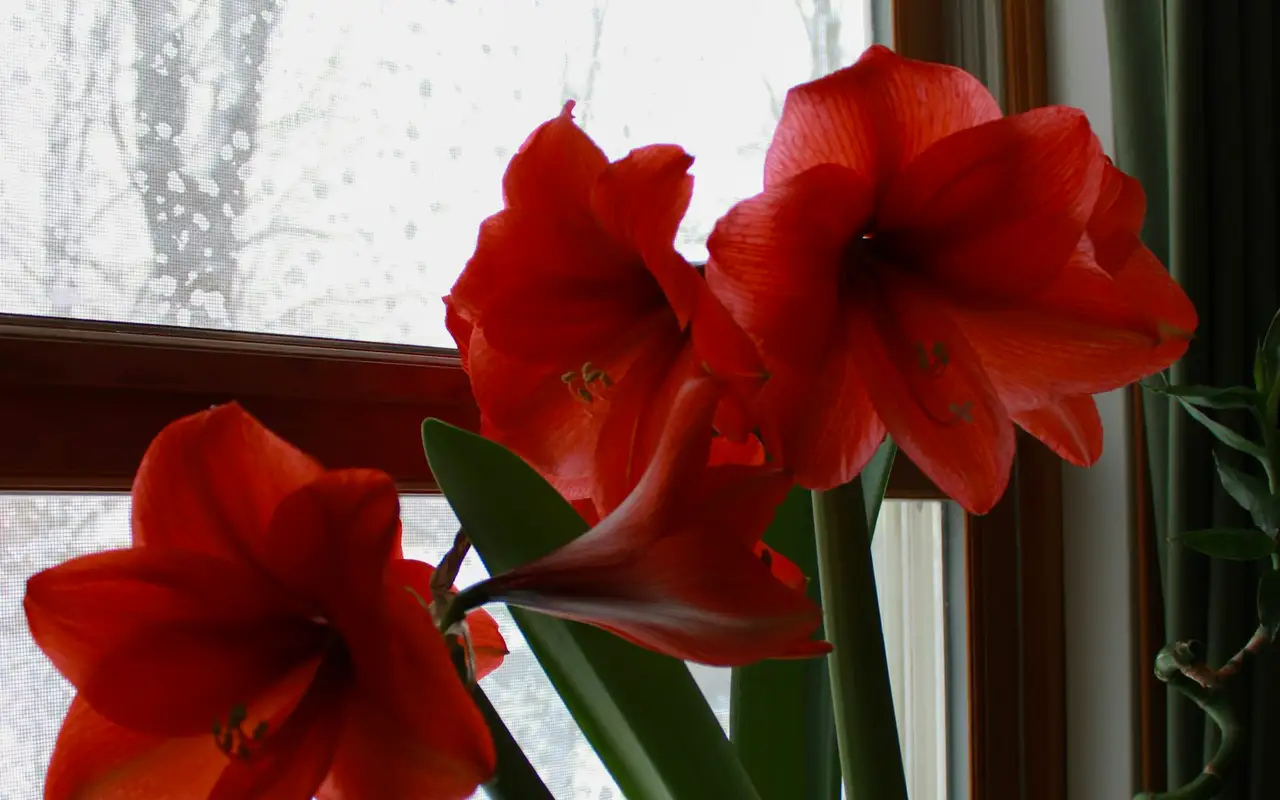
If your cat just chewed the amaryllis someone gave you for the holidays, here is the answer first. Are amaryllis toxic to cats? Yes. The ASPCA lists amaryllis as toxic to cats and dogs, and the plant in December gift boxes, Hippeastrum, is filed under its Barbados lily entry: vomiting, drooling, and diarrhea, with convulsions, low blood pressure, tremors, and heart rhythm problems after large ingestions. “Bulbs are the most poisonous part.”
Now the calibration. Amaryllis is not a true lily, so it does not cause the kidney failure that makes lilies a cat emergency. A cat that nibbles a leaf or petal usually drools, vomits, and recovers. A cat that chewed the bulb needs a call to your vet or a poison hotline now, before symptoms start.
Cat ate amaryllis? Call ASPCA Animal Poison Control at 888-426-4435 or Pet Poison Helpline at 855-764-7661 (both 24/7, a fee may apply) if your cat chewed the bulb, ate more than a nibble, or keeps vomiting. Do not give hydrogen peroxide.
TL;DR
- Amaryllis is toxic to cats, per the ASPCA. The toxins are lycorine and related alkaloids, plus irritating oxalate crystals (Pet Poison Helpline).
- The holiday amaryllis is Hippeastrum. Its ASPCA entry is the stricter of the two “amaryllis” entries: large ingestions can cause convulsions, low blood pressure, tremors, and heart arrhythmias.
- The bulb is the danger. It is the most poisonous part, and waxed bulbs and boxed bulb kits put it at counter height.
- A nibble usually means early, short-lived vomiting and drooling. In a dog study, lycorine vomiting started and stopped within 2.5 hours.
- It is not a true lily. No kidney failure, and pollen is not the hazard it is with lilies.
- Call now for: any bulb chewing, a large amount, repeated vomiting, tremors, wobbliness, collapse, or trouble breathing.
- Never give a cat hydrogen peroxide. Let the vet decide about vomiting.
- Dogs: the same ASPCA entries apply, and dogs are more likely to eat a whole bulb.
- Swaps: Christmas cactus, moth orchid, and African violet are all ASPCA non-toxic.
Are amaryllis toxic to cats?
Yes. The ASPCA lists amaryllis as toxic to cats. The holiday amaryllis (Hippeastrum) contains lycorine and other alkaloids that cause vomiting, drooling, and diarrhea. The bulb is the most poisonous part, and the ASPCA warns that large ingestions can cause tremors, convulsions, low blood pressure, and heart rhythm problems.
How worried to be depends on which part your cat got into.
| Part or exposure | Risk to cats | Why | What to do |
|---|---|---|---|
| Bulb, chewed or eaten (waxed bulbs too) | Highest | ASPCA: “Bulbs are the most poisonous part.” Oxalate crystals concentrate there too | Call a hotline or your vet now, even if your cat seems fine |
| Leaves or flower stalk | Low for a nibble, higher for a lot | Pet Poison Helpline: leaves, stems, and bulbs contain the alkaloids | Nibble: watch. A lot: call now |
| Flowers and petals | Low for a nibble | NC State lists flowers among the poisonous parts | Watch for drooling and vomiting |
| Pollen on fur | Not a documented separate hazard | Neither ASPCA nor Pet Poison Helpline singles it out | Wipe it off with a damp cloth |
| Brushing past, sap on fur | Very low | NC State: does not cause contact dermatitis | Wipe paws and fur |
“Toxic” in the ASPCA database covers everything from a plant that upsets a stomach to one that shuts down kidneys. Amaryllis sits in the middle: mostly a vomiting plant, with real systemic effects when a cat eats enough, and the bulb is where “enough” happens. For the far end of that range, see why lilies are toxic to cats.
Which amaryllis do you have? Hippeastrum vs. belladonna lily
The ASPCA files “amaryllis” under two different plants, and most pet pages quote the one that is not on your windowsill. NC State Extension flags the same problem: “The common name amaryllis can lead to some confusion because there is a genus also called Amaryllis that is native to South Africa.”
| Holiday amaryllis | Belladonna lily | |
|---|---|---|
| Botanical name | Hippeastrum | Amaryllis belladonna |
| ASPCA entry | Barbados lily (also fire lily, lily of the palace, ridderstjerne, amaryllis) | Amaryllis (also belladonna lily, Saint Joseph lily, Cape belladonna, naked lady) |
| Where you meet it | Boxed bulb kits, waxed bulbs, potted gift plants in winter | Garden bulb in mild climates; pink flowers on bare stalks in late summer |
| Native to | Central and South America | South Africa |
| ASPCA clinical signs | Vomiting, salivation, diarrhea; “large ingestions cause convulsions, low blood pressure, tremors and cardiac arrhythmias. Bulbs are the most poisonous part.” | Vomiting, depression, diarrhea, abdominal pain, hypersalivation, anorexia, tremors |
| NC State poison severity | Medium | Low |
If yours arrived as a bulb in a box, a wax-dipped bulb, or a potted plant blooming between Thanksgiving and February, it is the Hippeastrum. NC State notes that in colder zones these bulbs “are grown as houseplants for a pop of color during the winter holidays.”
Both are toxic to cats. The practical difference is the ceiling: the Hippeastrum entry is the one that spells out heart and blood-pressure effects from large ingestions. For a cat that nibbled one leaf, the two entries read about the same.
One myth to drop: “belladonna” does not link this plant to the nightshade Atropa belladonna. NC State explains the name comes from the Italian bella donna, “beautiful lady.”
Is amaryllis a true lily?
No. Pet Poison Helpline says it directly: “the Amaryllis is not a true lily.” It belongs to the amaryllis family (Amaryllidaceae), not the lily family, though some pet sites still file it under lilies.
The difference matters more than any other fact on this page. The ASPCA’s Easter lily entry lists “kidney failure, and death is possible. Cats are only species known to be affected.” Neither amaryllis entry mentions the kidneys, and both list dogs as affected too. A lily bite is a race against kidney damage over the next 72 hours. An amaryllis bite is a stomach problem unless your cat ate a lot.
Why amaryllis is poisonous to cats: lycorine and oxalate crystals
Two things in the plant make cats sick.
Lycorine and related alkaloids. The ASPCA lists “lycorine and other alkaloids” as the toxic principle. Pet Poison Helpline describes them as phenanthridine alkaloids that cause “dose-dependent vomiting, hypotension (drop in blood pressure), tremors/seizures, and respiratory depression.” Dose-dependent is the key phrase: a nibble triggers vomiting, a bulb can reach the rest of that list.
Raphide oxalate crystals. These are needle-shaped crystals. Pet Poison Helpline says “excess salivation and abdominal discomfort can be seen from the raphide oxalate crystals, which are more concentrated in the bulbs.” They explain the drooling and mouth-pawing that often come first.
Lycorine is, above all, a vomiting trigger. A University of Leipzig team gave beagles measured doses and found nausea and vomiting started at 0.5 mg/kg; every dog vomited at 2 mg/kg (Kretzing et al., 2011). The vomiting was “short-lasting,” came within 2.5 hours, and the dogs’ blood work stayed normal. It works so reliably that the same group is now developing lycorine as a drug vets could use to make dogs vomit after a poisoning (Regenthal and Abraham, 2023).
That explains the usual outcome of a nibble: the plant makes the cat throw it up. Two honest caveats. Those studies injected purified lycorine into dogs, not plant material into cats. And no published study sets a safe amount of amaryllis for a cat, so treat a chewed bulb as serious regardless of size.
Amaryllis poisoning symptoms in cats: what to expect and when
Amaryllis poisoning shows up fast, which is the opposite of lily poisoning.
| When | What you may see | Source |
|---|---|---|
| While chewing or right after | Drooling, lip-licking, pawing at the mouth | Pet Poison Helpline (oxalate crystals) |
| First few hours | Vomiting, sometimes repeated; diarrhea; belly discomfort; refusing food; lethargy | ASPCA; vomiting within 2.5 hours in the dog lycorine study |
| Large or bulb ingestions | Tremors, wobbly walking, convulsions, slowed breathing, low blood pressure, irregular heartbeat | ASPCA Hippeastrum entry; Pet Poison Helpline |
| If vomiting or diarrhea continues | Dehydration and electrolyte loss | Kretzing et al., 2011 (lycorine antiemetic study) |
The expected course for a leaf or petal nibble is short: some drooling, a vomit or two, and a cat that is back to normal later that day. A cat still vomiting several hours later, refusing food, or acting weak is off that course. Call your vet.
Go to an emergency vet now for tremors or twitching, wobbliness, collapse, a seizure, labored or unusually slow breathing, or vomiting you cannot stop. Those are the large-ingestion signs from the ASPCA and Pet Poison Helpline lists.
My cat ate amaryllis: what to do now
- Move your cat away and collect what is left. Check the bulb for tooth marks; that single detail changes the urgency more than anything else.
- Wipe plant bits and sap from the mouth, paws, and fur with a damp cloth so your cat does not groom more off.
- Do not make your cat vomit. Never give hydrogen peroxide to a cat: a cat given 3% peroxide at home developed ulceration across about 60% of its stomach lining and was euthanized, and the authors concluded its use in cats “is not recommended” (Obr et al., 2017). Vets use safer injectable drugs.
- Call for advice:
- ASPCA Animal Poison Control Center: (888) 426-4435
- Pet Poison Helpline: (855) 764-7661
- Or your own vet. Both hotlines run 24/7 and may charge a consultation fee.
- Have the details ready: your cat’s weight, which part it ate (bulb, leaf, flower), roughly how much, when, and any symptoms so far. Keep the plant tag; it often says Hippeastrum.
- Bring the plant or a photo if you go in.
Bulb vs. leaf: how urgent is it?
| What happened | What to do |
|---|---|
| Chewed or ate any of the bulb, including a waxed bulb | Call a hotline or your vet now, before symptoms |
| Ate a lot of leaves or a whole flower stalk | Call now |
| Nibbled a leaf or petal, vomited once or twice, otherwise normal | Call a hotline for a case assessment; monitor at home if they advise it |
| Licked sap or pollen off its fur, no chewing | Wipe the fur; watch for drooling |
| Tremors, wobbliness, collapse, seizure, or trouble breathing | Emergency vet now |
A kitten or a small cat gets a bigger dose from the same bite, because the toxin’s effect scales with body weight (milligrams per kilogram). Call sooner for them, and tell the hotline about any heart disease, since large ingestions affect blood pressure and heart rhythm.
What the vet will do
There is no quick blood test for lycorine, so the vet works from your history and the plant itself. Expect some combination of:
- Decontamination. If the exposure was recent and your cat has not vomited, the vet may induce vomiting with an injectable drug, then may give activated charcoal to bind what remains.
- Anti-nausea medication. In the Leipzig dog studies, maropitant completely blocked lycorine-induced vomiting and ondansetron reduced it (Kretzing et al., 2011).
- Fluids for dehydration from vomiting or diarrhea.
- Monitoring heart rate, rhythm, and blood pressure after a bulb or a large ingestion, because those are the systemic effects the ASPCA lists.
Lycorine clears quickly. In the beagle study its half-life was under an hour, which matched how fast the vomiting stopped.
Are amaryllis toxic to dogs?
Yes. Both ASPCA amaryllis entries list dogs alongside cats, with the same signs and the same warning that the bulb is the most poisonous part. Most of the hard data on lycorine, including the 2.5-hour vomiting window, actually comes from dogs.
Dogs differ from cats in one way that matters: they are far more likely to eat a whole bulb. A dog that digs a bulb out of a pot, steals one from a bag, or chews up a waxed bulb has taken in the most concentrated part of the plant, and swallowed chunks can add a blockage risk on top of the toxicity. Call a hotline for any bulb ingestion. Hydrogen peroxide is sometimes used in dogs, but only when a vet or hotline tells you to.
For the rest of the holiday lineup, our guides cover how poinsettias affect dogs (mildly) and why lilies are a different story for dogs than for cats.
Waxed amaryllis, bulb kits, and other holiday traps
Amaryllis season creates exposures that do not exist the rest of the year.
Waxed amaryllis bulbs. These bulbs come sealed in a colored wax shell with no pot or soil, and they bloom without watering. That means the bulb, the part the ASPCA calls most poisonous, sits fully exposed on a coffee table or windowsill at cat height. The wax is decoration, not a barrier. A cat or dog that chews through it reaches the bulb.
Boxed kits and loose bulbs. A bulb waiting in its box or in a bag is the most concentrated amaryllis exposure there is. The American College of Veterinary Pharmacists’ amaryllis page says it plainly: “When storing bulbs indoors, keep away from pets and children.”
Cut stems in arrangements. Holiday bouquets sometimes include cut amaryllis. No bulb means a smaller dose, but stalks and flowers still contain the alkaloids. Our cat-safe bouquet guide lists arrangements that skip the problem flowers.
After the bloom. Gardeners often keep the bulb to rebloom next year, storing it dormant in a cool, dark spot. A dormant bulb in the garage, or a spent waxed bulb in an open trash can, is still a bulb. Seal it away.
Paperwhites in the same box
Holiday bulb kits often pair amaryllis with paperwhites. They are a Narcissus, a cousin in the same plant family, and the ASPCA lists paper white as toxic to dogs, cats, and horses with the same alkaloids, the same signs, and the same line: “Bulbs are the most poisonous part.” Treat them exactly like amaryllis.
Can you keep amaryllis in a home with cats?
Sometimes, and only for a cat that leaves plants alone. A high shelf is not out of reach for a cat that jumps, and a top-heavy amaryllis is easy to knock over. The setups that work:
- A room your cat never enters, with the door kept shut.
- Cut stems instead of a bulb, placed somewhere your cat truly cannot reach, if you want the flowers without the bulb.
- No amaryllis this year for a plant-chewer, a kitten, or a cat that has already gone for it once.
Our guide to keeping cats away from plants covers deterrents for the plants you do keep. And if you are the one giving the gift to a cat household, give one of the swaps below.
Cat-safe alternatives to amaryllis
These are listed non-toxic to cats by the ASPCA.
| Swap | ASPCA status | Why it works |
|---|---|---|
| Christmas cactus (Schlumbergera) | Non-toxic to cats, dogs, horses | The holiday-blooming gift plant cat households can keep. More in our Christmas cactus guide |
| Moth orchid (Phalaenopsis) | Non-toxic to cats, dogs, horses | Big, showy flowers on a spike, sold everywhere in winter. See orchids and cats |
| African violet (Saintpaulia) | Non-toxic to cats, dogs, horses | Compact, flowers indoors, fits a windowsill |
| Scarborough lily (Cyrtanthus elatus) | Non-toxic to cats, dogs, horses | The closest look-alike: red trumpet flowers on a bulb |
The Scarborough lily needs two notes. It blooms in late summer or early autumn, so it is a year-round look-alike, not a December swap. And one of its common names, “fire lily,” is also an ASPCA name for toxic Hippeastrum, so buy it by botanical name. ASPCA files it under its older name, Vallota speciosa; the two names are the same plant.
For more flowering options, see our cat-safe flowers list.
Amaryllis relatives: which are toxic to cats
The amaryllis family is not uniformly toxic, which is one more reason to check the plant, not the family.
| Plant | ASPCA status for cats | Notes |
|---|---|---|
| Paperwhite, daffodil, jonquil (Narcissus) | Toxic | Same alkaloids and signs as amaryllis; bulbs worst |
| Clivia (Clivia) | Toxic | Same sign list as Hippeastrum, word for word |
| Chives (Allium schoenoprasum) | Toxic | Different toxin and mechanism: damages red blood cells |
| Scarborough lily (Cyrtanthus elatus) | Non-toxic | See swaps above |
| Prairie lily (Zephyranthes drummondii) | Non-toxic | Outdoor rain lily |
The real holiday emergency for cats is not in this family at all. It is the true lilies tucked into bouquets: Easter, Asiatic, Oriental, and stargazer lilies. If a bouquet arrives with lilies, that is the one to remove first. The other seasonal plants sit lower: poinsettias are mildly toxic, and the tree itself is a minor risk next to tinsel, as our guide to Christmas trees and cats explains.
What to skip
- Do not treat an amaryllis nibble like a lily emergency. Neither amaryllis entry lists kidney damage. You do not need a 72-hour kidney workup for a petal.
- Do not wait for symptoms after a bulb chew. Call first. The bulb is the one exposure where acting early matters.
- Do not give hydrogen peroxide or other home remedies to make your cat vomit.
- Do not assume the wax makes a waxed bulb safe. The bulb is still inside.
- Do not panic over a sniff or a brush past the plant. Amaryllis poisons when eaten.
- Do not trust the family name. Amaryllis-family plants range from non-toxic (Scarborough lily) to toxic by a completely different mechanism (chives). Look up the exact plant.
Frequently asked questions
Are hippeastrums poisonous to cats?
Yes. Hippeastrum is the botanical name for the amaryllis sold as a holiday bulb, and the ASPCA lists it as toxic to cats and dogs under the names Barbados lily, fire lily, lily of the palace, and ridderstjerne. The entry names lycorine and other alkaloids, lists vomiting, salivation, and diarrhea, and warns that large ingestions can cause convulsions, low blood pressure, tremors, and heart rhythm problems. The bulb is the most poisonous part.
How long does it take for amaryllis poisoning to show in cats?
Usually fast. Drooling and pawing at the mouth can start while the cat is still chewing, because of the oxalate crystals in the plant. Vomiting tends to follow within the first few hours: in a veterinary study where dogs were given lycorine, the main amaryllis alkaloid, vomiting began and ended within 2.5 hours. That is very different from true lilies, where kidney damage builds over 24 to 72 hours.
What part of the amaryllis is poisonous to cats?
All of it, but not equally. The ASPCA says the bulb is the most poisonous part, and Pet Poison Helpline says the irritating oxalate crystals are also concentrated in the bulb. Leaves, stalks, and flowers contain the same alkaloids in smaller amounts, so a nibbled petal is a much smaller exposure than a chewed bulb.
Can my cat get sick from touching amaryllis or licking the sap?
Brushing past the plant is not a poisoning. The ASPCA and Pet Poison Helpline describe illness from eating the plant, and NC State Extension lists amaryllis as not causing contact dermatitis. The realistic route is a cat licking sap or plant bits off its fur or paws, which is a small dose. Wipe the fur with a damp cloth and watch for drooling.
Is amaryllis pollen dangerous to cats?
Not in the way lily pollen is. Neither the ASPCA nor Pet Poison Helpline singles out amaryllis pollen as a hazard; their warnings are about eating the plant, especially the bulb. The fear comes from true lilies, where a little pollen groomed off the fur can cause kidney failure. Amaryllis is not a true lily. Wiping pollen off a dusted cat is still sensible.
Can amaryllis kill a cat?
It is unlikely from a nibble. The ASPCA and Pet Poison Helpline entries do not describe deaths, and the usual course is short-lived vomiting and drooling. The serious signs, convulsions, low blood pressure, heart rhythm problems, and slowed breathing, are tied to large ingestions, which in practice means a chewed bulb or a lot of plant. Treat any bulb chewing as a call-now situation.
What is the most toxic flower for cats?
True lilies: Lilium species such as Easter, tiger, Asiatic, and Oriental lilies, plus daylilies (Hemerocallis). They can cause kidney failure in cats from small exposures, including pollen. Amaryllis, despite names like belladonna lily and fire lily, is not a true lily and does not cause kidney failure.
The bottom line
Amaryllis is toxic to cats, and the plant you were most likely given, Hippeastrum, carries the ASPCA’s stricter warning. Calibrate by part: a nibbled leaf or petal usually means drooling and a quick round of vomiting, while a chewed bulb is a call-now exposure, and so are tremors or wobbliness after any amount. Keep bulbs, waxed or boxed, completely out of reach, give cat households a Christmas cactus or moth orchid instead, and save the true panic for lilies.
Emergency numbers (24/7, a fee may apply):
- ASPCA Animal Poison Control Center: (888) 426-4435
- Pet Poison Helpline: (855) 764-7661
Related articles
- Are Lilies Toxic to Cats?, the true-lily emergency amaryllis is often confused with
- Are Poinsettias Poisonous to Cats?, the milder holiday plant
- Are Christmas Cactus Toxic to Cats?, the holiday plant cats can live with
- Are Christmas Trees Toxic to Cats?, the tree, the water, and the tinsel
- Are Tulips Toxic to Cats? and Are Hyacinths Toxic to Cats?, two more bulbs where the bulb is the problem
Sources
Every verdict above was checked against the linked page on 2026-11-04.
- ASPCA: Amaryllis; Barbados Lily (Hippeastrum); Paper White; Clivia Lily; Easter Lily; Scarborough Lily; Toxic and Non-Toxic Plant List for Cats (chives, prairie lily, and the other Hippeastrum names)
- Pet Poison Helpline: Amaryllis; 855-764-7661, 24/7
- American College of Veterinary Pharmacists, Pet Poison Control: Amaryllis
- NC State Extension Gardener Plant Toolbox: Hippeastrum; Amaryllis belladonna
- Kretzing S, et al. Dose-dependent emetic effects of the Amaryllidaceous alkaloid lycorine in beagle dogs. Toxicon, 2011.
- Kretzing S, et al. In vivo assessment of antiemetic drugs and mechanism of lycorine-induced nausea and emesis. Archives of Toxicology, 2011.
- Regenthal R, Abraham G. Dimethyl sulfoxide favors the emetic efficacy of lycorine in beagle dogs. Research in Veterinary Science, 2023.
- Obr TD, et al. Necroulcerative hemorrhagic gastritis in a cat secondary to the administration of 3% hydrogen peroxide as an emetic agent. Journal of Veterinary Emergency and Critical Care, 2017.
- Wikipedia (citing Kew’s World Checklist): Cyrtanthus elatus, synonym Vallota speciosa